Maria de Guadalupe de Lencastre, 6th Duchess of Aveiro
Kino Writes To The Duchess
Sor Juana Writes About The Duchess
View Entire Book and Download in PDF Format "Kino Writes to the Duchess .."
Links to sections of "Kino Writes to the Duchess" with footnotes in pdf format.
To download, click on the blue colored book section name. There is no file numbered 05.
Front Matter
Table of Contents
INTRODUCTION
I. A Biographical Sketch of Kino
II. Messages from and about Kino to the Duchess summary Kino correspondence
III. The Duchess: A Biographical Note
IV. Letters and Documents from and to the Duchess summary 200 other letters
CORRESPONDENCE OF KINO
Kino’s Non Spanish Letters
Bibliography, Abbreviations, Addenda
Index
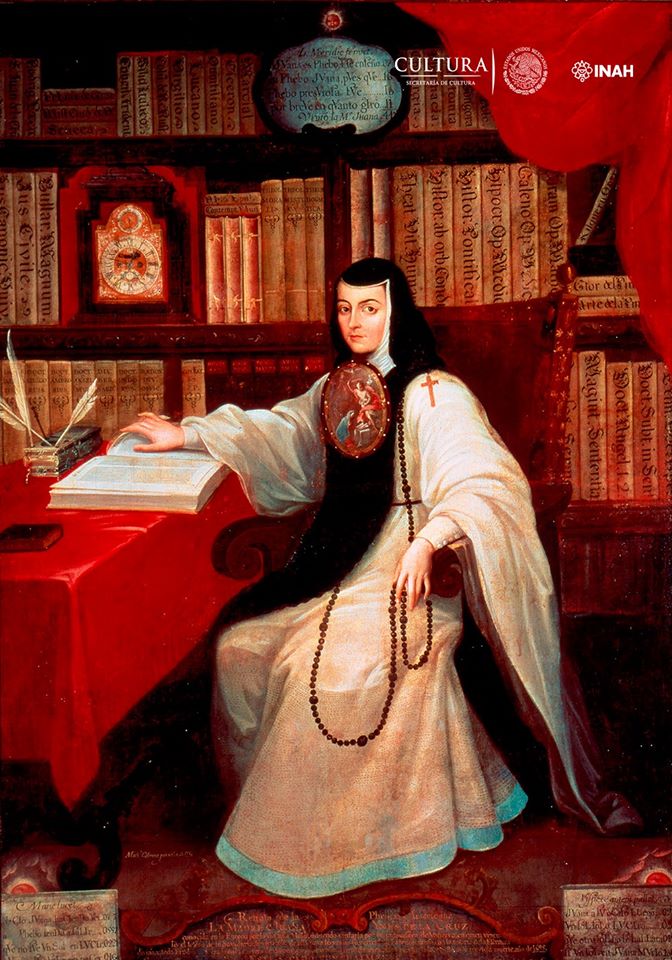
Sor Juana Inés de la Cruz
Sor Juana Writes About The Duchess
“Romance” Number 37 Poem
La respuesta a sor Filotea”
[Response to Sister Filotea]
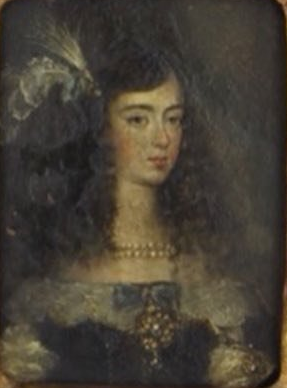
Maria de Guadalupe de Lencastre, 6th Duchess of Aveiro
Ernest J. Burrus
The Book Kino Writes to The Duchess & Biographical Note about The Duchess
The first volume [Kino Writes to the Duchess: Letters of Eusebio Francisco Kino, S.J., to the Duchess of Aveiro] offers in translation the letters written by Father Kino to the Duchess of Aveiro and by others to her concerning the renowned missionary of northern Mexico and southern Arizona. In the general introduction some 200 letters of other correspondents are briefly summarized.
The Portuguese Duchess residing in Madrid was the most generous benefactress in colonial times of the foreign missions throughout the world. At the decisive moment when the Patronato lands, Spain and Portugal, could no longer offer sufficient economic assistance to the missions of the Americas, Africa, the Philippines and the Marianas, and the Far East, the Duchess donated unprecedented sums to assure their foundation and continued maintenance. Her home in Madrid, with its staff of secretaries and copyists, was the clearing house and information center of the world-wide missionary activity during nearly half a century (before 1670 to her death in 1715). Her generosity set an effective example to the founders of the Pious Fund of the Californias. No less important was her encouragement of the publication of significant scientific, historical, and literary books. |x-xi| ....
(1) "Mother of the Missions"
|19| At a time when Spain and Portugal found it increasingly difficult to finance, in accordance with the Patronato Real [38] the vast number of missions in their own territory and beyond their dominions, many missionaries turned to the Duchess of Aveiro for effective assistance. China, India, the Philippines, Mexico, Peru, and especially the Marianas received her generous financial help. She set aside property to help educate future apostolic workers, and she encouraged the more enterprising and intrepid missionaries to strive to re-enter forbidden Japan.
For nearly half a century she assisted the missionaries and inspired them to write numerous reports and personal letters, which, despite the toll of time, still constitute a vast fund of |20| historic, geographic, ethnologic and other scientific data. She not only sent missionaries across the oceans, built and maintained seminaries, she also encouraged and financed the publishing of learned works on mathematics, theology, literature, natural sciences, etc. Her home in Madrid became the information center for the foreign apostolic work effected by missionaries from every country of Europe and of the mission areas themselves. “Mother of the Missions” was not an empty but a well-deserved title. She herself summed up her ambition in life and the times - when she said that she hoped to build as many Catholic churches as Elizabeth of England had destroyed or confiscated.
Her interests were manifold. She had considerable linguistic ability, reading Portuguese, Spanish, French, Italian and Latin with facility, and German to a slight degree; she was not, however, very successful in writing in any language except in her native Portuguese. She is credited with being a painter of no little talent. As we have indicated, the Duchess was a person of considerable influence at the courts of Madrid, Lisbon and Rome, as also at the headquarters of not a few religious Orders. This will become more evident as we glance at the correspondence which reached her through the years, but first a word about her place in Portuguese and Spanish nobility.
(2) Portuguese and Spanish Titles [39]
María de Guadalupe de Lencastre, sixth duchess of Aveiro, duchess of Arcos and Maqueda, oldest daughter of Jorge de Lencastre (first duke of Torres Novas and oldest son of the third duke of Aveiro), and of his second wife, Ana Henriques de Cárdenas (daughter of the duke of Maqueda), was born on January 11, 1630 in Azeitão, Portugal. Thus, by birth she was a Portuguese of the highest nobility, and descendant of the famous English adventurer, John of Gaunt; hence the name Lencastre (Lancaster). On the death of her uncle, Pedro de Lencastre, fifth duke of Aveiro, the fate of the title was uncertain until by official Portuguese decision |21| it was conferred on María de Guadalupe, on October 20, 1679; thus, she became the sixth duchess of Aveiro.
By October of 1663, she had already come to stay in Spain, when the goods of her eldest brother, Raimundo de Lencastre, in the service of Spain and charged with treason to Portugal, were confiscated by the Portuguese Crown, and his titles as fourth duke of Aveiro and of Torres Novas were taken away from him. María de Guadalupe married in 1665 the Spanish duke of Arcos, sixth of that title, Manuel Ponce de León de Lencastre. Joaquín became the seventh duke of Arcos, inheriting the father’s title; Gabriel was given the title of the mother's house, thus becoming the seventh duke of Aveiro. Isabel married into the prominent Spanish house of Alba, her husband being the ninth duke of that title.
A pre-nuptial clause exacted by the Duchess stipulated that the Portuguese and Spanish titles were to remain separate: the oldest boy was to inherit the former; and the second, the latter [40] When her brother Raimundo was declared a traitor to his country in October of 1663 and lost his Portuguese titles to become the Spanish duke of Ciudad Real, the title of the Portuguese house was conferred on their uncle, Pedro de Lencastre. And when the latter died on April 1, 1673, goods and titles were again in litigation, until María de Guadalupe, on October 20, 1679, was declared victorious over other claimants. An essential condition of obtaining the title of duchess of Aveiro had been to come personally to Portugal and make obeisance to the Portuguese King. María agreed to do so. Her husband violently objected. This led at the beginning of 1678, more than a year before the final decision, to the legal separation of the couple, which seems to have been permanent. [41]
The Duke died on November 23, 1693. [42] The Duchess lived over twenty years longer, dying on February 9, 1715. She lies buried in the celebrated shrine of Guadalupe in the mountains of Estremadura, Spain. [43] |22|
Despite the legal separation from the Duke, the Duchess kept the title of Arcos which she had added to that of Aveiro; the third title, that of Maqueda, came to her through her mother, the Marquesa de Maqueda. [44] The unjust and tragic destruction of the house of Aveiro by the Portuguese prime minister Pombal in 1759 kept the title from surviving to the present. [45]
As we have seen, Gabriel, the younger son, became the seventh Duke of Aveiro. Inasmuch as he did not marry and had no descendants, the title at his death on July 23, 1745, was again the object of prolonged litigation. It was not until September 30, 1755 that the Portuguese King, José, conferred the title on José Mascarenhas da Silva e Lencastre, marquis of Gouveia and count of Santa Cruz. [46] Jubilant in his victory, he could not dream what terrible tragedy was in store for him and all his dear ones. Above all, he could not have imagined to what length the ambitions of a Pombal could go. José Mascarehnas had married into another powerful noble Portuguese house, that of Távora, by taking as wife on July 21, 1739, the daughter of the count of Alvor, Leonor Tomásia de Távora e Lorena. The couple was blessed with six children: two boys and four girls. No Greek tragedy could even remotely approach the terrible reality in store for the entire family and even their relatives.
On the night of September 3, 1758, an attempt was made on the life of the reigning sovereign, José, as he was returning from one of his nocturnal adventures. His prime minister, the notorious marquis de Pombal, grasped the splendid opportunity of breaking the might of the noble houses of Aveiro and Távora by accusing the head of the former of being one of the instigators of the attempt on the King's life, and utterly destroying morally and even physically his influential and illustrious lineage. [47]
|23| The Duke of Aveiro was mercilessly tortured, his arms and legs being broken on the wheel in the presence of his oldest son Martinho, burned alive and his ashes thrown into the river. [48] Imprisonment was the lot of the rest of the family, even of the youngest, Francisca, nineteen months old. That Pombal's vengeance might have its fill, all the family's property including the baby’s cradle was auctioned off publicly. [49]
The ducal palace was razed along with all the other buildings on the estate; the ground was plowed and sown with salt, and a pillar erected with the prohibition of ever building on the property again. [50] Thus disappeared the Aveiro title. [51] A benigner fate awaited the lineage in Spain through the marriages of Isabel into the house of Alba, and of Joaquín who perpetuated the title of Arcos.
Ernest J. Burrus
III. The Duchess: A Biographical Note
Kino Writes to the Duchess:
Letters of Eusebio Francisco Kino, S.J., to the Duchess of Aveiro
To view and download the original book pages with footnotes in pdf format, click
Kino_Writes_To_The_Duchess_Burrus_03_Duchess_Biography_pp_19-23
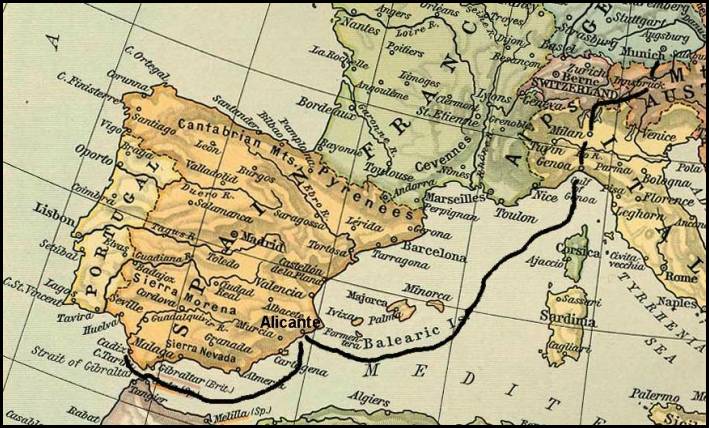
Map of Kino's Journey From Bavaria To Spain & 2 Year Layover in Seville and Cadiz
Ernest J. Burrus
Messages from and about Kino to the Duchess
Kino Correspondence Summary
|3| From here [the port of Genoa] he sailed with fellow Jesuit missionaries across the Mediterranean to Alicante, Spain. By ship again, his group continued to Cadiz, where they arrived in time to see the fleet bound for the Indies receding in the glow of the setting sun.
This meant a minimum of two year's waiting, which with the subsequent shipwreck could easily have extended to four. Kino proceeded to Seville and there took lodging in the college of San Hermenegildo, the regular hospice of foreign missionaries.
During the long wait (1678-1680) Kino was not idle. He perfected his knowledge of Spanish and studied mathematics and the natural sciences. As a practical application of his scientific knowledge he made numerous astronomical instruments. Among the Jesuits he came to know in Seville was the future General of the Order, Tirso González, who later would defend him against false accusations and save him for the missions of northern Mexico.
The next seven years of Kino's life are mirrored in the correspondence which we are here editing. The last of these letters leave Kino at the threshold of his nearly quarter of a century apostolate in behalf of Sonora, Lower California and Arizona, one |4| of the most successful in all history. Death stilled his generous heart on March 15, 1711, at Santa María Magdalena, Sonora. ...
II. Messages from and about Kino to the Duchess
The first of Kino's letters to the Portuguese Duchess of Aveiro, Arcos y Maqueda, resident in Madrid, is dated from Cadiz, Spain, August 18, 1680, and his last to her is sent from Los Frailes, Sonora, Mexico, en route to his permanent mission center of Nuestra Señora de los Dolores, on February 15, 1687. Others write to the Duchess about Kino as late as August 6, 1687. Only one document pertinent to the present volume by the Duchess has survived: a brief memorandum championing the California enterprise; merest chance seems to have kept it from the waste-paper basket.
Twenty of the letters were addressed by Kino directly to Her Excellency; nearly as many others were forwarded by various recipients of Kino's messages or were written by them directly to her and kept with Kino's letters because they mentioned him and his work.
The thirty-seven documents which constitute the correspondence of Kino to the Duchess enable us to an extent not possible from any other sources to learn about Kino's plans and ideals for work in the Orient, in California, and finally in the vast territory which was to be his home for nearly a quarter of a century, Sonora and Arizona.
(1) Delayed in Spain (Letters I-X)
Shipwreck on July 11, 1680 in the harbor of Cadiz threatens to detain Kino in the country for many months, which might easily stretch into years. The two years which he had already waited in Spain was a long time for an active man of his ideals, |5| seemingly interminable for so zealous a missionary longing to reach the field of his activity.
By August 18, 1680, over five weeks had gone by since the shipwreck which interrupted his voyage to Mexico. That day he decided to write to the Duchess in the hope that she would help him fulfill a dream cherished for so many years, that of working as a missionary to the Chinese. From other missionaries Kino knew that María Guadalupe de Lencastre, Duchess of such an illustrious Portuguese house as that of Aveiro, married to the Spanish Duke of Arcos, was willing to use her prestige and influence no less in the courts of Lisbon and Madrid than in the Jesuit curia and papal congregations of Rome.
It was an Italian Jesuit, Teofilo de Angelis, en route to the missions of the Orient, who first suggested to Kino to enlist the Duchess’s aid in his cause. De Angelis had spoken to Her Excellency in Madrid. She had heard about the request of the South Sea Islanders for Catholic missionaries, and she encouraged DeAngelis to promote an expedition to their land and help effect their conversion." De Angelis, in turn, told her of Kino's dreams to work in the Orient, and suggested that she help arrange to have him assigned as his companion in the South Sea venture.
To understand Kino's reluctance in writing sooner and his apparent contradictory frame of mind evidenced in some dozen letters to follow, we must remember that Kino as a Jesuit was forbidden by his rule and prudence to enlist outside influence in order to change or direct the decisions of his superiors.' If kings, grandees and duchesses had the decisive say in the appointment of the |6| individual Jesuit, generals and provincials of the Society of Jesus would become their merest puppets; the help and influence of the former could be enlisted under the direction of superiors, but not in order to paralyze the latter’s' effective government. In his first letter, Kino recounts the shipwreck and informs the Duchess that De Angelis had written to the General requesting him as his companion for the South Sea expedition and apostolate.
The Duchess writes thrice before Kino sends his next letter, on September 15, 1680. Although none of these or other messages of the Duchess to Kino have survived, we can know much of their contents from Kino's replies. Obviously, she expressed the desire that he work in her own favorite missions, those of the Mariana Islands. Kino answers that he would most gladly work either there or help open up the South Sea missions: his one norm of action is the will of his superiors, which for him is the expression of God's will.
During the some two and a half months from November 16,1680 to January 26, 1681, Kino writes to the Duchess six letters which have been preserved, and a seventh to Father Espinosa [1o] of Seville was forwarded to her. None of the many replies of the Duchess to these letters seem to have survived. Two themes claim the greater part of Kino's letters: first, a circular letter written [11] |7| by Father Ferdinand Verbiest, [12] an eminent scientist and influential missionary in China, sent to his fellow Jesuits in Europe, pleading with them that they furnish helpers for a field that seemed so ripe for the harvest; second, a huge comet, studied by Kino in Spain and later in Mexico.
Kino clung to the Verbiest letter as to a life-saver; one that would rescue him from an unwanted destination and enable him to realize his boyhood dreams of the Chinese missions. Verbiest underscored the role that science had played at the Peking court in winning imperial favor for the Jesuit missionaries, enabling them to effect their extensive apostolic work. His call was for volunteer Jesuit scientists. Kino was fitted by nature, inclination and a long meticulous training to answer the appeal. Surely, Father General, on reading Verbiest's plea and Kino's offer, would give a favorable reply.
Kino realized that the Duchess might well ask why it was that with such a large contingent going to the Orient, he was not among them. He tells her how he lost in a pious gamble with Anton Kerschpamer (Cereso), a fellow Jesuit, who drew the coveted Orient and he the unwanted assignment to Mexico. Kino never makes it altogether clear whether he considered this hard luck on his part or a manifest sign of Providence. [13]
A word about Kino's vocation to the Chinese missions. They were, of course, very much in the mission accounts read with such avidity in Europe at the time. Distant and exotic lands fascinated |8| for centuries knowledge-thirsty Europeans to a degree scarcely comprehensible today. Kino in his idealism saw in China an adequate field for his desire to help others in time and eternity.
His relative, Martino Martini, the Jesuit missionary who succeeded in reaching China in 1643, was delegated to return to Europe in 1650 in order to make known the needs of the Chinese missions. [14] He was in Italy from at least 1654 to 1657. The normal route from Holland, where he published his monumental Atlas of China, [15] to Rome was via Trent. Kino was nine years old at the time; he was still in his native town of Segno when Martini presumably arrived in the historic city. Kino nowhere tells us whether he saw his famous kinsman, but later he did read his writings and studied his superb maps.
When Martini sailed from Lisbon in 1657 with a large contingent of Jesuit missionaries for China, Verbiest accompanied him. Verbiest had been waiting several years in Spain for a chance to get to the Spanish American missions, the very ones which Kino now considered as less desirable. Jesuit missionaries bound for China from Kino's home Province were Adam Schall, Beatus Amrhyn and Adam Aigenler, who accompanied the Sicilian Prospero Intorcetta. [18] Johann Adam Schall von Bell, to give the missionary his full name, was born in Cologne in 1591, entered the Order in 1611, and reached China in 1622. He was soon asked to reform the Chinese calendar and later was appointed president of the board of mathematics. He wrote and published numerous scientific works in Chinese. His history of Christianity in China was first published in Vienna in 1665, the very year Kino joined the Jesuits. |9|
Aigenler," born in Tramin, in Kino's home diocese of Trent, set out for China in 1673, but died on August 26th of that year, a victim of his charity towards the plague stricken on board ship. With him was Amrhyn of Lucerne, Switzerland, born in 1632, who met a like fate.
Prospero Intorcetta, born in 1625 in Piazza Armerina, Sicily, accompanied in 1657 Martini to China. In 1666 he was deputed to explain in Rome the problems of the Chinese missions; it was on the return voyage of this second trip that Amrhyn and Aigenler went with him. Nine of the ten missionaries who accompanied him to China, died during the voyage - the most disastrous of China expeditions.
Many years later when Kino came to write his diary, he recalled the heroism of these men. [18] Kino now felt that it was to this group that he belonged. It was to their Chinese missions, where his scientific ability and training could be best employed, that he aspired. Yes, and in all sincerity he was convinced that he possessed the strength of character necessary for such an exacting enterprise. The next prominent theme of Kino's letters at this period is the comet. He keeps the Duchess au courant of his scientific findings. He writes at greater length to Father Espinosa and later composes an entire treatise on the subject to be published in Mexico City the very year of his arrival there, 1681. [19] We have used the text of the treatise in the commentary to the letters on the comet. Kino was not satisfied to report what he saw and what his mathematical calculations revealed; the philosopher in him strove to explain the nature of the celestial phenomenon and ask the question on everyone's lips: “Did the comet forebode good or evil”? Kino replied that the comet presaged, but did not cause, evil; he insisted that like all things created it was subject to God and His Providence and hence the disasters and calamities about which it warned men. God could also avert. |10|
From the Canary Islands Kino sent letters to Europe; [20] on February 24, 1681, he wrote to the Duchess and asked her to forward the enclosures to Rome. The Duchess generously saw to it that the messages were sent on as requested.
Ernest J. Burrus
II. Messages from and about Kino to the Duchess
Kino Writes to the Duchess:
Letters of Eusebio Francisco Kino, S.J., to the Duchess of Aveiro
To view and download the original book pages with footnotes in pdf format, click
Kino_Writes_To_The_Duchess_Burrus_02_Messages_From_and_About_Kino_To_Duchess_pp_04-18
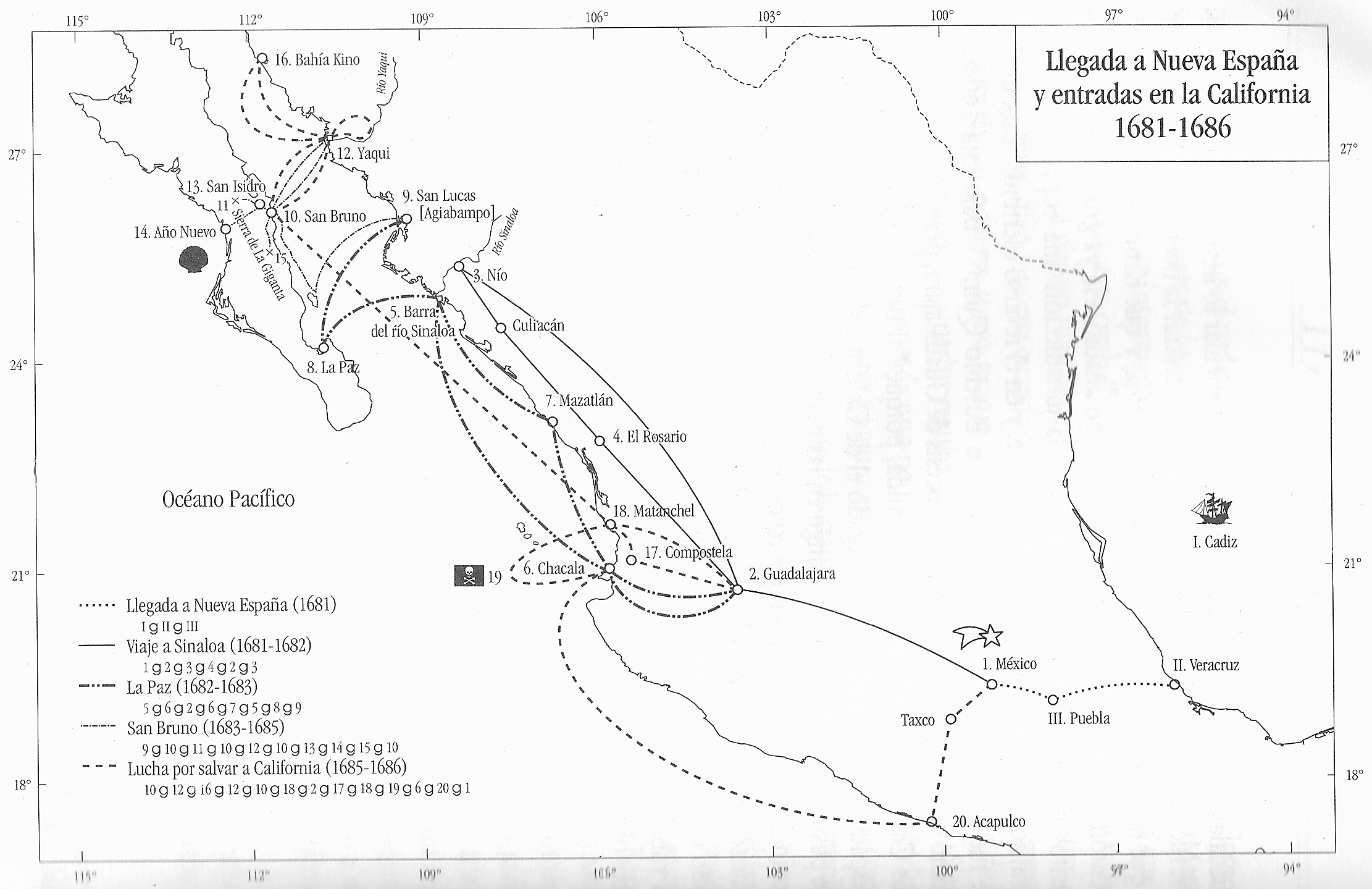
Map of Kino's Mexican Mainland, The Californias and Pacific Ocean Journeys
While Writing To the Duchess from 1681-1687
Ernest J. Burrus
Messages from and about Kino to the Duchess
Kino Correspondence Summary (Continued)
(2) In Mexico City (Letters XI-XIII)
Kino reached Vera Cruz, Mexico, at the beginning of May, 1681. His first extant letter to the Duchess is dated July 4, 1681. Mexico City was busy with two expeditions: one to explore California and the other to recover New Mexico from the rebellious Pueblo Indians. [21] Kino was no less a realist than an idealist. His lifelong dreams were of China, nor had he left untried all human means to reach it. The representative of the Philippine missions, Father Baltasar Mansilla, had been enlisted in his cause: Kino hopes that with his assistance he can reach the Islands and then somehow continue to China. [22] But he is also a realist: he is needed for the California expedition, as scientist (specifically as cartographer to help mark off boundaries and delineate reliable maps) and as missionary to the natives. Kerschpamer, the Jesuit who won in the gamble |11| against Kino the coveted mission of the Philippines, may be forced by poor health to accept an assignment in Mexico; this would mean that Kino would take his place as a missionary to the Orient. The Jesuit seminarist, José Gregorio, in his letter of October 9, 1681, is the first to inform the Duchess that a definite decision has been reached: Kino is to participate in the California enterprise.
(3) On to California (Letters XIV-XVI)
Others had informed the Duchess of Kino's appointment to the California expedition; now he does so personally in his message from Nuestra Señora del Rosario on June 3, 1682, en route to the island or peninsula he knows not which. He is too sincere to attempt to hide his satisfaction with the new assignment which will replace the once hoped-for destination to China. He has not forgotten his days in Cadiz; as a souvenir of his uncertain delay there, he sends the Duchess copies of his treatise on the comet. [23]
Kino had no small designs for California. The first “city” to be established there - Nuestra Señora de Guadalupe de las Californias - will both honor Our Lady of Guadalupe and give expression to Kino's gratitude to the Duchess. When he writes his next message on November 3, 1682, from Chacala, he is closer to his desired goal. He has time only to jot the merest note, but does repeat his previous assurance that he sent to the Duchess copies of the treatise on the comet. He also reports very briefly on the voyage thus far completed; between lines one can glimpse his bright hopes for the future.
The Chaplain of the Viceregal couple, Fray Francisco Jiménez, wrote on December 11, 1682, while Kino was sailing Californiaward,a veritable newsletter to the Duchess: a report from Bishop Barrientos in the Philippines of his voyage there via the Marianas, the efforts being made to reconquer New Mexico, a eulogy of the Viceregal couple, and the Viceroy's effective support of the California enterprise. |12|
(4) Efforts at Conquest, 1683-1685 (Letters XVII-XXVIII)
Kino's first message from California was written to his fellow Jesuit in Mexico City, Francisco de Castro. [24] It was dated from La Paz (Nuestra Señora de Guadalupe de Californias, the city which Kino promised to name after the Duchess and in honor of Our Lady of Guadalupe), April 20, 1683. It is written in diary-form from the day the expedition left the mouth of the Sinaloa River to the time of its composition; much of it will later be incorporated into the earliest printed report on the California enterprise(number XXIII of this volume). This and the next two messages were forwarded to the Duchess.
The crossing is recounted, the landing detailed, the latitude discussed, the region described, the natural resources enumerated; but most of the letter is devoted to an optimistic account of the natives, with emphasis on their sharpness of mind, goodness of heart, and their favorable reaction to the truths and ritual of the faith. It is characteristic of Kino to stress human rather than economic values.
On April 23rd, a second message from California this time a very brief word - is penned to Father Francisco de Castro; Kino summarizes the previous message and asks that the successful entry be reported to numerous friends, officials and acquaintances, the Duchess among them. He is busy as missionary to the Indians, learning their language, as cartographer drawing accurate maps, and as historian writing a detailed report on the area. More than three months go by before Kino finds time to report again. He makes up for his silence by writing at considerable length to Father Castro. [25] Kino has crossed over to San Lucas in Sinaloa on the Mexican mainland in order to secure much needed supplies for less productive California. It is from this Sinaloan port that he signs and sends his message, although much of it had been written diary-wise before leaving the peninsula. |13|
At long last, on August 12, 1683, Kino takes time out to write directly to the Duchess. His ship is still at anchor in the harbor of San Lucas, Sinaloa. He summarizes earlier messages sent to her, most of which have failed to survive.
Mansilla, the treasurer of the Marianas, out of gratitude to the Duchess for her generosity and interest in her favorite mission field, writes to her from Mexico City. [26] Among the letters which he is forwarding to her is one from Kino.
Kino has much to report to the Duchess in his message of December 15, 1683. After the treacherous and tragic slaughter of the Indians by Atondo at La Paz (what irony in the name!), the expedition was forced to try its fortune farther north, at San Bruno. Two land expeditions to explore the region have been undertaken; the reaction of the natives everywhere has been favorable.
To better inform more persons about the California enterprise, an account was compiled from the letters of Kino and Atondo and printed in Mexico City as a small brochure of eight pages, before the year 1683 was out. [27] The report was soon reprinted: the first time, through an intriguingly interesting coincidence, as an appendix to Verbiest's account of the Chinese Emperor's trips to |14| Tartary (printed in Paris in 1685); the Recueil de Voyages au Nord,vol. III, lst. ed (Amsterdam, 1715) reprinted both Píccolo's 1702 Informe and the 1683 California report; the second edition of this work reproduced these same accounts. [28] Both editions of Lockman’s Travels of the Jesuits (London, 1743 and 1762) published extracts in English of the 1683 brochure. Kino's teacher, Father Heinrich Scherer, proudly published (Munich, 1703 and many subsequent editions) Kino's 1685 California map and reports; Scherer's Latin text agrees substantially with Kino's 1683 letters and the Atondo Kino imprint of this same year. [29]
Nearly a year goes by before Kino again writes to the Duchess a letter that has survived. The message is dated from San Bruno, California, October 25, 1684. Kino has made his solemn religious profession in the little church of San Bruno; on the simple altar burned the incense thoughtfully sent by the Duchess. Kino is optimistic about the future of the California enterprise. Father Francisco Florencia, dean of studies of the principal Jesuit college in Mexico City, forwards to the Duchess, on November 1, |15| 1684, a recent letter from Father Kino and gives in his own message an idea of its content. [30]
On December 8, 1684, Kino writes to the Duchess two letters from San Bruno, California. Storm signals are in the air. Kino fears for the future of the enterprise despite the building of a second fort, that of San Isidro, and a projected inland expedition. He implores the Duchess to intercede in behalf of the California enterprise.
Kino did not take part in Atondo's “Second Expedition” carried out early in 1685; Father Goñi accompanied the Admiral. [31] The latter has left us a very detailed account of the exploratory trip. Kino's report is brief, fragmentary and obviously drawn from the account (oral or written) of some of the participants of the expedition.
They set out from San Bruno on February 16, 1685. Every attempt to find a pass through the Sierra Giganta which blocked the way westward proved unavailing. The exploring party, forced back from every probe of the unyielding monster, was obliged to skirt the eastern coast. Five trying days brought them to the bay of San Dionisio. Here at the village of Cumchó (later to become known as Loreto de Conchó, the modern Loreto), Chief Ibó, a staunch friend from earlier days, came to see them. They then continued southward as far as a spot marked by Kino on his 1685 map as San Augustín, opposite the large island of Carmen. With every canyon westward still proving to be a blind alley rather than a pass, the party turned northward, skirting the eastern shore to reach San Bruno on March 6, 1685.
(5) Apparent Defeat (Letters XXIX-XXXIII)
The far-flung Spanish Empire could now spare no more for the California enterprise; no, not even a pittance by way of a paltry reward for the millions saved by the Atondo-Kino rescue of the Manila Galleon was forthcoming. Unfounded rumors of |16| Indian disturbances in Nueva Vizcaya (northwestern Mexico) served as a pretext for improvident and jittery officials to suspend the California expedition. Pirates raiding Spanish American coastal cities and capturing Spanish ships were draining none too replenished royal coffers. Unsuccessful efforts to regain New Mexico proved that the Indian was a stubborn and costly foe to vanquish. [32] An increasingly inefficient monarchy in the home country did not help the unpromising situation.
Father Mansilla, writing to the Duchess from Mexico City on March 13, 1686, gives us our first notice of Kino's return to the Capital and his efforts to save the California enterprise. He writes her a second time (on April 4th), assuring her that Kino is reporting to her at length. Kino’s first extant message is dated July 19, 1686. He recounts the now well-known rescue of the Manila Galleon and its millions of pesos; but, uppermost in his mind while writing to her, is the heartless abandonment of the California Indians. It is for them that he begs the Duchess to intercede with influential royal officials. Kino is not one to brood over seemingly irretrievable losses; he is already planning wholeheartedly future conquests: from the region of the Seri and Guayma Indians as a springboard, he will return to California. In his next letter, from Mexico City, November 16, 1686, he enlarges on his plans for the conquest of California from the Mexican mainland, and again implores the Duchess to mediate in behalf of the abandoned natives of California.
Less than two weeks after Kino's letter, Mansilla again writes to the Duchess, this time to inform her that Kino has written to her at length about the intention of royal officials to give up the California enterprise.
(6) Victory at Last (Letters XXXIV-XXXVII)
Kino is on his way to his new field of apostolic work. [33] He writes to the Duchess on February 15, 1687, from the mining town of Los Frailes, near the present city of Alamos, Sonora. Others |17| might speak pessimistically and lugubriously about empty coffers and bankruptcy; Kino sees wealth about him on very side: highly productive mines, and fertile lands for stock and crops. With a bit of practical intelligence and good will an infinitesimal part of their yield would support the missions and secure the conversion of the natives. It is the latter who are uppermost in his mind; to protect them from unjust impressment he has secured a royal decree.
Kino established his permanent northern mission not along the western shore of the Mexican mainland, as he had intended, but far inland, among the Pimas of Sonora. Why this radical change of plans? From the context of numerous letters, we learn that when he came to the area about Bamotze or Cosari he found that the numerous Pimas so well disposed towards the faith were without a missionary. At the suggestion of the Jesuit superior of the entire chain of missions in that region, Father Manuel González, Kino established his mission here; it was to be his home until death would claim him over twenty-four years later. He called the settlement Nuestra Señora de los Dolores, after a painting given to him by his renowned artist friend of Mexico City, Juan Correa. [34]
A fellow Jesuit, Adam Gilg. [35] also a volunteer to the northern missions, devoted himself to the Seris and neighboring tribes, an apostolate that Kino had once planned for himself. Kino’s next two letters, the last of the entire series, are written to Father Mansilla from Nuestra Señora de los Dolores, and dated June 30th and August 6, 1687. The letters glow with contagious optimism in reporting the unprecedented success of Kino in winning over the natives. Victory at long last! Presumably, the letters were taken personally by Mansilla to the Duchess. [36]
These were Kino's last messages to the Duchess. That he did not continue to write to her, should not greatly amaze anyone, inasmuch as he was destined to spend the remaining twenty-four years of his life in isolated northern Mexico and her main interest was in the missions of the Orient. What, however, may well seem most puzzling is that never again does he mention the Duchess |18| in any of his subsequent writings - not even in his detailed Diary, where he speaks of so many others to whom he was far less indebted. How explain this strange silence? I know of no completely satisfactory explanation, but shall suggest what I hope is not an utterly unreasonable conjecture. Kino's final corrections of his Diary date from 1708 to 1710, well within Philip V's reign.
Unlike earlier sovereigns of Spain, Philip does not seem to have favored the house of Aveiro, especially as the Duchess had made every effort to safeguard the Portuguese title and family inheritance in the land of its origin. It would have been most impolitic and imprudent of Kino to mention in a book dedicated to a Bourbon king, the name of a Portuguese noblewoman who was not held in high favor by the new dynasty. His interest, however, in the missions of China and of the Orient in general never waned.
In all the various plans which he worked out for the development of the vast regions in Sonora, Arizona, the two Californias, and adjacent territories, he invariably considered them as stepping-stones to the distant lands of the Orient (consult Memoir, II, pp. 259-261; Kino Reports, pp. 120-123; Kino's Plan, pp. 31, 33). Keeping in mind the tragic and disastrous rites controversy which so clearly led to the destruction of the Chinese and other Oriental missions, Kino considered that he had been providentially assigned to the more fruitful mission territory. He devoted all of chapter IV, book II, part IV (Memoir, II,,pp. 143-146) to give expression to his conviction: “Comparison of these new American Missions of this unknown North America with the Asiatic missions of the Mariana Islands and of Great China”.
The correspondence is brought to a close with the Memorandum in the Duchess's writing; it is an eloquent plea to resume the California enterprise. It is undated, but obviously was written after she received Kino's reports from Mexico City indicating the suspension of all efforts to continue with the settlement of the peninsula.
Ernest J. Burrus
II. Messages from and about Kino to the Duchess
Kino Writes to the Duchess:
Letters of Eusebio Francisco Kino, S.J., to the Duchess of Aveiro
To view and download the original book pages with footnotes in pdf format, click
Kino_Writes_To_The_Duchess_Burrus_02_Messages_From_and_About_Kino_To_Duchess_pp_04-18
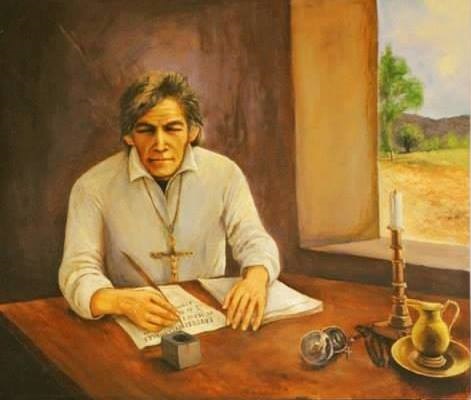
Padre Kino Writing The Duchess
Artist Jose Cirilo Rios Ramos
View Entire Book and Download in PDF Format "Kino Writes to the Duchess .."
Book Download in PDF Format
Kino Writes to the Duchess: Letters of Eusebio Francisco Kino, S.J., to the Duchess of Aveiro; an Annotated English Translation, and the Text of the Non-Spanish Documents [with footnotes]
Ernest J. Burrus.
To download, click on blue colored link of the file name below the book section.
Front Matter.
Kino_Writes_To_The_Duchess_Burrus_000_Front_Matter_pp_I-VII
Table of Contents.
Kino_Writes_To_The_Duchess_Burrus_00_Table_of_Contents_pp_IX-XII
INTRODUCTION
I. A Biographical Sketch of Eusebio Francisco Kino (1645-1711).
Kino_Writes_To_The_Duchess_Burrus_01_Kino_Biography_pp_01-04
II. Messages from and about Kino to the Duchess (summary of Kino correspondence)
Kino_Writes_To_The_Duchess_Burrus_02_Messages_From_and_About_Kino_To_Duchess_pp_04-18
III. The Duchess: A Biographical Note
Kino_Writes_To_The_Duchess_Burrus_03_Duchess_Biography_pp_19-23
IV. Letters and Documents from and to the Duchess (summary of 200 other letters)
V. The Original Manuscripts of the Present Correspondence
Kino_Writes_To_The_Duchess_Burrus_04_Letters_and_Documents_from_and_to_the Duchess_pp_23-67
CORRESPONDENCE OF KINO [and about Kino]
Kino_Writes_To_The_Duchess_Burrus_06_Correspondence_of_Kino_pp_69-214
Kino’s Non Spanish Letters
Kino_Writes_To_The_Duchess_Burrus_07_Non_Spanish_Letters_pp_217-239
Bibliography, Abbreviations and Addenda
Kino_Writes_To_The_Duchess_Burrus_08_Bibliography_Abbrevations_pp_241-257
List of Kino Letters
Kino Writes To The Duchess
KINO WRITES TO THE DUCHESS
LIST OF LETTERS
[Editor Note: This is not the original table of contents but derived from it. The list does not have page numbers nor references to letters in original Italian and Latin with references to corresponding English translation as in the table of contents. Also sections and letters are referenced with the addition of Arabic numbers.
To view and dowload original Table of Contents with page numbers and references to corresponding translations, click
Kino_Writes_To_The_Duchess_Burrus_00_Table_of_Contents_pp_IX-XII]
List of Letters
Kino Writes To The Duchess:
Letters Of Eusebio Francisco Kino, S.J., To The Duchess Of Aveiro;
An Annotated English Translation, And The Text Of The Non-Spanish Documents
Ernest J. Burrus
FRONT MATTER
Introducing a New Series
[SECTION 01] INTRODUCTION
[01] I. A Biographical Sketch of Eusebio Francisco Kino (1645-1711)
[02] Π. Messages from and about Kino to the Duchess
[03] III. The Duchess: A Biographical Note
[04] IV. Letters and Documents from and to the Duchess
[05] V. The Original Manuscripts of the Present Correspondence
[SECTION 02] CORRESPONDENCE OF KINO
[01] I. Kino writes to the Duchess,* from Cadiz, August 18, 1680
[02] II. Kino writes to the Duchess from Cadiz, September 15, 1680
[03] III. Kino writes to the Duchess from Cadiz, November 16, 1680
[04] IV. Kino writes to the Duchess from Cadiz, December 6, 1680
[05] V. Kino writes to the Duchess from Cadiz, December 14, 1680
[06] VI. Kino writes to the Duchess from Cadiz, December 28, 1680
[07] VII. Kino writes to Espinosa (in Seville) from Cadiz, January 8, 1681
[08] VIII. Kino writes to the Duchess from Cadiz, January 11, 1681
[09] IX. Kino writes to the Duchess from Cadiz, January 26, 1681
[10] X. Kino writes to the Duchess from the Canaries, February 24, 1681
[11] XI. Kino writes to the Duchess from Mexico City, July 4, 1681
[12] XII. Gregorio writes to the Duchess from Mexico City, October 9, 1681
[13] XIII. Klein writes to a fellow Jesuit in Bohemia, February 16, 1682
[14] XIV. Kino writes to the Duchess from Nuestra Señora del Rosario, June 3, 1682
[15] XV. Kino writes to the Duchess from Chacala, November 3, 1682
[16] XVI. Jiménez writes to the Duchess from Mexico City, December 11, 1682
[17] XVII. Kino writes to Castro (in Mexico City) from Nuestra Señora de Guadalupe, California, April 20, 1683
[18] XVIII. Kino writes to Castro (in Mexico City) from Nuestra Señora de Guadalupe, California, April 23, 1683
[19] XIX. Kino writes to Castro (Mexico City) from San Lucas, Sinaloa, July 27, 1683
[20] XX. Kino writes to the Duchess from San Lucas, Sinaloa, August 12, 1683
[21] XXI. Mansilla writes to the Duchess from Mexico City, August 13, 1683
[22] XXII. Kino writes to the Duchess from San Bruno, California, December 15, 1683
[23] XXIII. An Accurate Report (on California) by Atondo and Kino
[24] XXIV. Kino writes to the Duchess from San Bruno, California, October 25, 1684
[25] XXV. Florencia writes to the Duchess from Mexico City, November 1, 1684
[26] XXVI. Kino writes to the Duchess from San Bruno, California, December 8, 1684
[27] XXVII. Kino writes to the Duchess from San Bruno, California, December 8, 1684
[28] XXVIII. Kino's account of the second expedition into California (1685)
[29] XXIX. Mansilla writes to the Duchess from Mexico City, March 13, 1686
[30] XXX. Mansilla writes to the Duchess from Mexico City, April 4, 1686
[31] XXXI. Kino writes to the Duchess from Mexico City, July 19, 1686
[32] XXXII. Kino writes to the Duchess from Mexico City, November 16, 1686
[33] XXXIII. Mansilla writes to the Duchess from Mexico City, November 29, 1686
[34] XXXIV. Kino writes to the Duchess en route to Dolores, February 15, 1687
[35] XXXV. Kino writes to Mansilla (in Mexico City) from Dolores, June 30, 1687
[36] XXXVI. Kino writes to Mansilla (in Mexico City) from Dolores, August 6, 1687
[37] XXXVII. Memorandum (in behalf of the California enterprise) by the Duchess
[SECTION 3] NON-SPANISH LETTERS
[Omitted is a list of Kino letters transcribed from original Italian and Latin with references to the corresponding letters above in English translation.]
BIBLIOGRAPHY
ABBREVIATIONS
ADDENDA
INDEX
ILLUSTRATIONS
1. Model of the statue of Father Kinо
2. Portrait of the Duchess and children
3. The Duchess
MAPS
4. The Upper German Province, drawn by Aigenler
5. The 1684-1685 Atondo-Kinо expedition, delineated by Ives
* During her correspondence with Kino, the Duchess resided in Madrid.
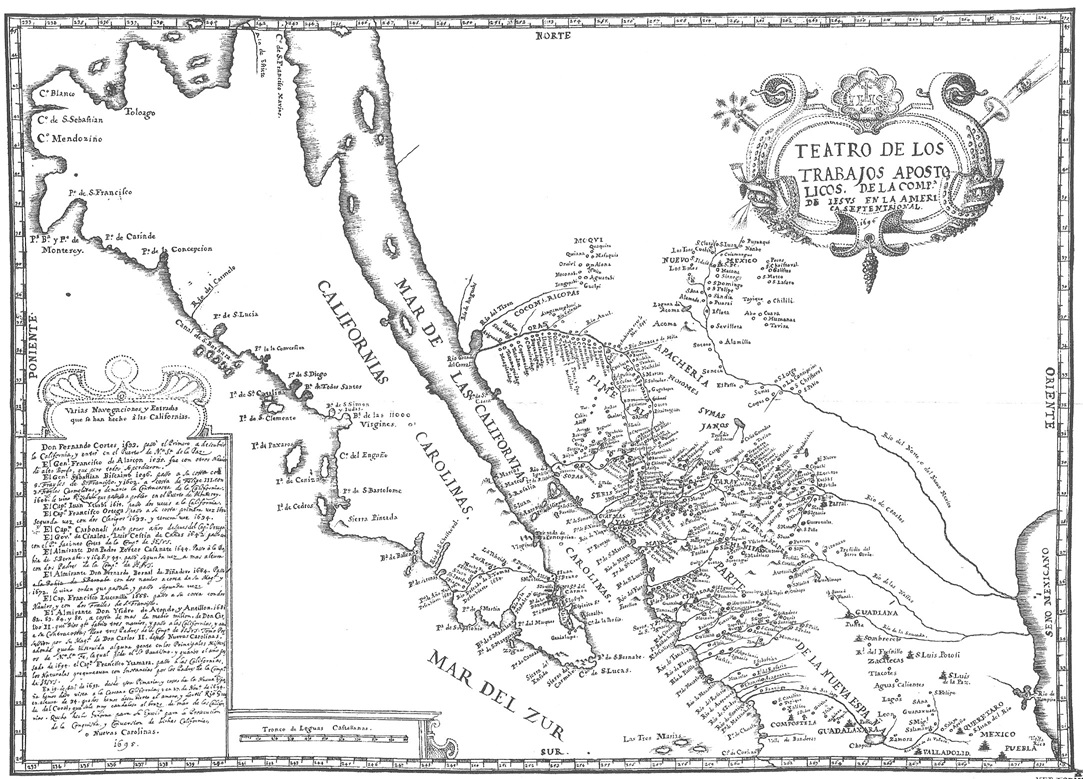
Kino's Hand Drawn Teatro de Los Trabajos Map 1695
With Kino's History of Previous Attempts To Settle The Californias in Lower Left
Download Map at https://repository.arizona.edu/handle/10150/623456.
Four Selected Kino Letters and
Duchess California Memorandum
Kino Writes To The Duchess
Cadiz - September 15, 1681
Mexico City - July 4, 1681
Mission San Bruno - December 8, 1684
Mexico City - November 16, 1686
Duchess's Memorandum on the Importance of The Return to The Californias
To view and download the original book pages with footnotes of entire Kino letters and correspondence in pdf format, click
Kino_Writes_To_The_Duchess_Burrus_06_Correspondence_of_Kino_pp_69-214
and
Kino_Writes_To_The_Duchess_Burrus_07_Non_Spanish_Letters_pp_217-239
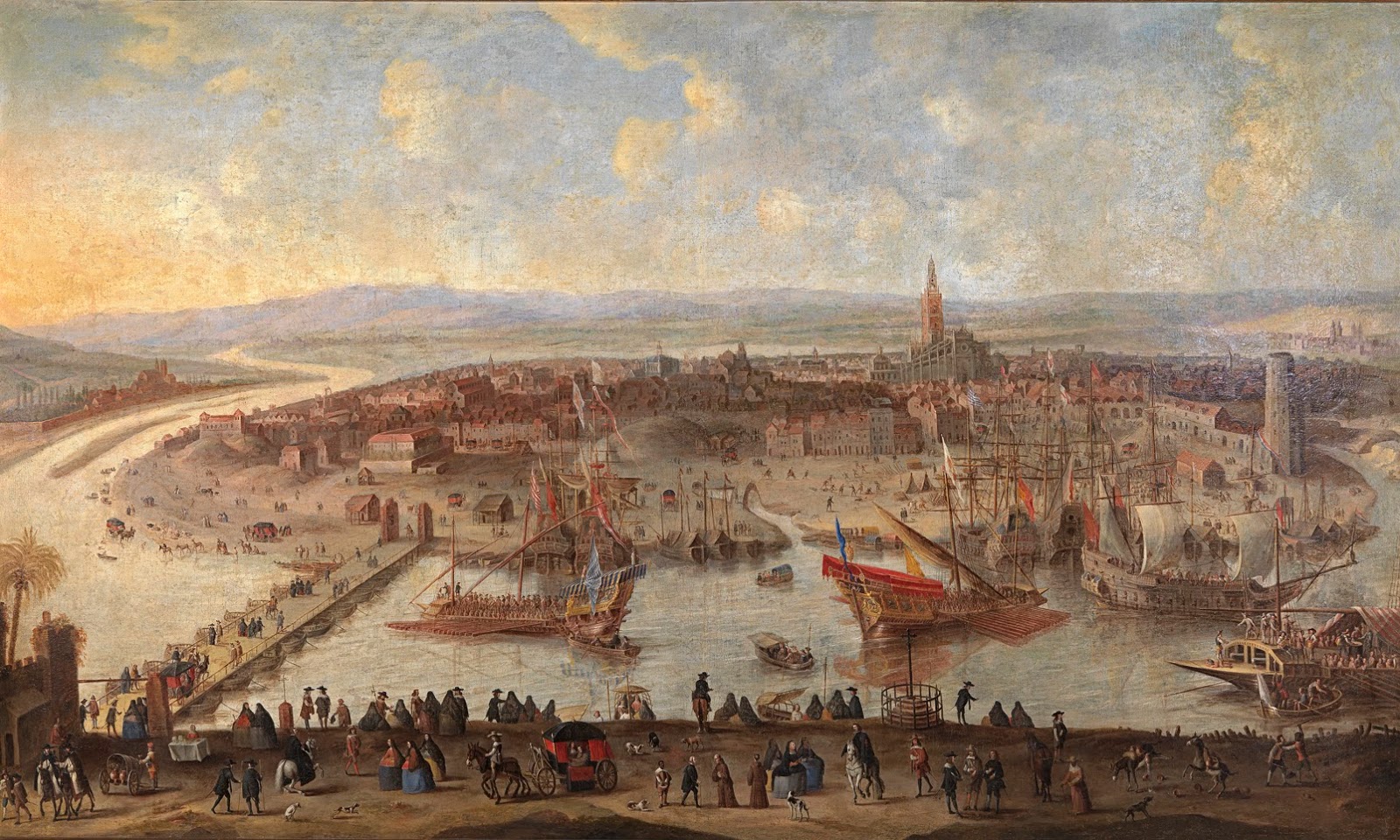
"Quien no ha visto Sevilla, no ha visto maravilla."
Seville During Kino's 2 Year Stay in Southern Spain
Kino's Letter From Cadiz
September 15, 1680
Summary Letter II: |73| Kino writes in Spanish to the Duchess from Cadiz, September 15, 1680. He acknowledges the receipt of her three letters and extends a word of greeting in German to her from his companions. The missionaries marking time in Cadiz, hope to set sail before the year is out. Kino would gladly work in the Marianas, had another destination not been assigned to him; but should De Angelis's letter to the Jesuit General secure authorization for the southern expedition, he will enthusiastically participate in it. Scraps of news: pirate raids, epidemic in Puerto de Santa María, missionaries for Paraguay. He asks that his enclosed letter be forwarded to the Jesuit General. [1]
Your Excellency:
May the peace of Christ Jesus be with you!
Recently I received three letters [2] from your Excellency. I am most grateful to you for the kindness expressed in them to me and to my fellow missionaries en route to the Indies, to whom I was mindful of extending your Excellency's cordial greetings; they, in turn, send their best wishes and most deferential thanks. [3] |74|
We are all well, God be thanked, except Father Paul Klein [4] (one of the four German missionaries who are living in Seville) who had to be bled recently. I trust that by God's goodness he will soon be enjoying perfect health and can happily join us in the bright prospects which by God's grace they offer us of still continuing this year our voyage to New Spain [5] in the Honduras ships, or in the dispatch boat [6] which sails directly to Vera Cruz, or finally in the Windward fleet, about which your Excellency, to my profound consolation, informs me.
May we sail in the way that redounds to the greater glory of God and in accordance with His most holy will, for the eternal and limitless wisdom knows what is best in every contingency that can befall His creatures, and without whose decision not «a hair of our head shall perish.[7] »
For my part I can not imagine enjoying greater consolation than that experienced in Spain and elsewhere through the words of the great saint and teacher of divine love, Saint Theresa, who says that hope attains to all it hopes for. [8] In the same way the Divine Spirit sustains us by the promise that, «Every place that your foot shall tread upon, shall be yours.» [9] And, of course, the variant reading, « Every place to which your hope shall reach, will be yours, » is even more inspiring. Nor can hoping and then |75| attaining be less satisfying than attaining what can no longer be hoped for.
I am delighted at the news which your Excellency via Holland [10] concerning the Mariana Islands; nor do I think that Our Lord will abandon that portion of His vineyard, enriched as it has been by the precious blood of martyrs. And although some may hold that it is not possible to continue in that mission field menaced as it is by such great dangers, it would be better to recall that all dioceses, provinces and countries converted to the light of the gospel of Christ, had at the beginning to endure difficulties, suffering and adversity; but those who realize that « Christ had to suffer and thus enter into His kingdom, [11] » will not be frightened by what has happened.
I also trust in the divine goodness and in the favors which the great and angelic Saint Francis Xavier [12] confers and will confer on those devoted to him that it will not be for want of Jesuit missionaries that others are sought for and sent to the missions.
In Germany the Jesuits have the highest regard for the Mariana missions, and long to be sent to convert their inhabitants. More than two hundred aspirants are seeking entrance into the Upper German Province. [13] Our Lord will not be deaf to such fervent pleas of the many who truly prefer to suffer and work generously for their Savior and for the salvation of these natives than enjoy the bliss of heaven in the company of the angels.
All of us missionaries residing the past two years in Seville, would have considered it a special blessing had our superiors sent us to the Marianas. Obedience alone, which is « better than sacrificial victims, [14] » could lessen the disappointment which some of us experienced when Rome assigned to us New Spain as our destination.
And because of this appointment I have not dared and will not dare ask to go elsewhere unless superiors order or request me to do so. I never lacked the desire or the courage; it was with |76| that very intention that I studied mathematics, [15] namely to use the knowledge, if God so wished, in the missions of the Orient. But all this in union with the deeds and merits of Christ Our Lord and of all the Saints, I have offered as a sacrifice to the ever wondrous divine goodness.
Nonetheless, I am deeply appreciative of and grateful for the exceptional kindness offered to me by your Excellency in your second letter [16] of promising to secure passage to China from Lisbon. If perchance the letters written by Father Teofilo [17] to Rome before his departure from Europe should secure authorization for me to be his companion in the voyage of the discovery of the southern lands close to the Marianas, this would be one of the greatest satisfactions of my life; but I do not request it; let my superiors so order me.
May the divine love fill the soul and heart of your Excellency and increase its celestial gifts in you so intent on the conversion of the Marianas and other regions both known and unknown. « May God strengthen what he has wrought in us [18] » since according to the great Dionysius the Areopagite, [19] « the most divine of all divine deeds is to secure the salvation of the neighbor for the glory of God.>>
Within the last four days the Honduras ships came into port and brought the tragic news that the French, English and other pirates plundered Porto Bello and laid siege to Panama City; the raiders were planning to continue to Lima. [20] They also bring word that rich mines of high percentage gold have been discovered between Panama and Cartagena. Within the past three days three |77| Vizcayan ships have put into port, which they say are part of the Windward fleet (or «Little Armada »).Day before yesterday, an Augustinian friar abandoned his monastery two months after making his religious profession; some are wondering whether he left on board one of the English ships which set sail today from this harbor. Puerto de Santa María, God be thanked, is free from the pestilence, according to the report of the delegates who visited the city recently. We are awaiting the sixty missionaries destined for Paraguay. They are to come here from Seville in order to sail on board the Buenos Aires ships from the continent within a few days, as it seems. Some, however, say that their departure will be delayed for some weeks yet. I beg of your Excellency to send the other letter to Father Tirso. [21] Your Excellency will be so good as to pardon my forwardness in sending to you the parchment with that sacred Name for which you are expending such signal efforts «that it be made known to the gentiles. [22] » And with this I commend myself most earnestly to your holy prayers and good works.
May God watch over your Excellency for may years to come and grant to you abiding happiness, as I pray of Him and desire.
Cadiz, September 15, 1680.
Devotedly yours,
Eusebio Francisco Kino
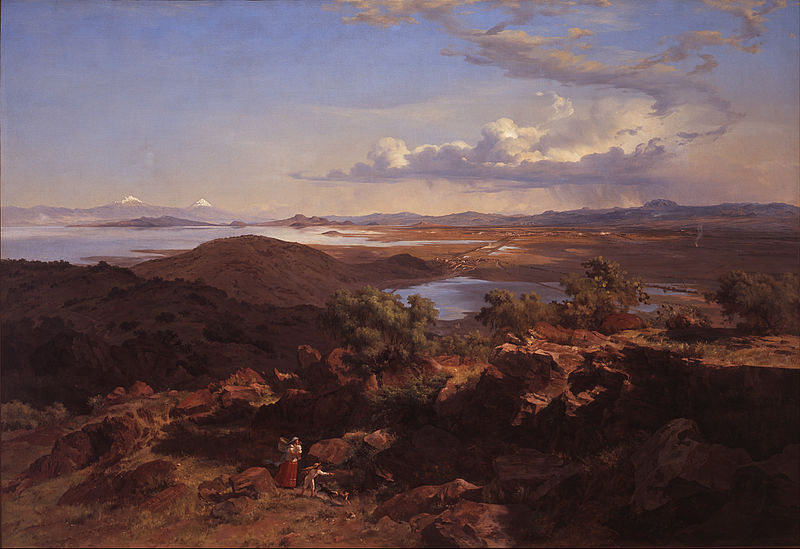
El valle de México desde la cumbre del Cerro de Santa Isabel
[The Valley of Mexico from the Santa Isabel Mountain Range]
Artist José María Velasco
Kino's Second Letter From Mexico City
July 4, 1681
Summary Letter XI: |109| Kino writes to the Duchess from Mexico City, July 4, 1681. Father Mansilla dispatched all of Kino's letters by diplomatic pouch. Unless the fleet sails sooner than planned, Kino will let the Duchess know to what mission he has been assigned - the Orient, Mexico or California. Favorable attitude of Father Mansilla and Vidal towards the missions. Mansilla is trying to effect Kino’s passage to China, but the California expedition may need him. The one hope is for Kerschpamer to remain in Mexico and for Kino to take his place in the Orient. At the shrine of Nuestra Señora de Guadalupe. Earthquake in Mexico. [1]
Your Excellency:
The Peace of Christ Jesus and the Love of Our Lord be with you! A month ago, within the first days of my arrival in Mexico City, I wrote to your Excellency, giving you an account of our entire trip and voyage to the missions. [2] Quite likely, that letter will reach you at the same time as this one. I entrusted all my letters to Reverend Father Baltasar de Mansilla, [3] Procurator of the Philippines and Marianas, to put them in a mail pouch sent from Mexico to the Spanish court in Madrid.
Reverend Father Baltasar de Mansilla is favorably interested in the eastern missions, especially the Marianas. When in the preceding month of March he sent those missionaries who had |110| arrived here in the fleet ten months previously, [4] he wrote to the Reverend Father Superior of the Mariana Islands [5] to keep for that mission as many as he wished. He will write to the same effect regarding the other missionaries (who two months ago came herewith me on the dispatch boat), when he sends them, God willing, to the Orient. As is evident, he makes every effort to help the Marianas.
Reverend Father Baltasar is also trying to get me to China. Accordingly, a few days ago, he spoke about the matter to Reverend Father Provincial [6] of the Mexican Province in the endeavor to secure me for his own eastern missions. Reverend Father Provincial, who is planning on sending me to California in the company of a veteran missionary, [7] when within a few months (if God so wishes) ships, soldiers and a goodly contingent set out to explore more carefully than heretofore that extensive island or peninsula, [8] has not yet given his final decision to Reverend Father Baltasar. He will probably do so when Father Antonio Cereso [9] comes here from Puebla in some two or three weeks. [10] Although he is the one designated for the Philippines, he will quite likely remain in the Mexican Province because of the great difficulties which he experienced during the voyage; and so, perhaps, I can manage to be sent to the Orient in his place. In the meanwhile, I dare not prefer, ask for or desire one mission rather than another, lest I be reminded: « You know not what you are asking for. » [11] But until then, I am earnestly commending every day this intention to Our Lady of Guadalupe, so that superiors decide what is most pleasing to the all good Lord. And when for this purpose I go every week to say Mass at the sacred shrine of the Virgin Mary, Mother of God, Our Lady of Guadalupe, [12] I am careful to commend, as well as I can, the |111| intentions of your Excellency, of your husband and of your three dear children, Joaquín, Gabriel and Isabel.
I am writing this letter on her feast; [13] and, hence, I am sending her an image of Our Lady of Guadalupe and a pious chain; I would have the latter be a symbol of her close attachment to Our Lord. The other four images I should like to give to the other four members of your devoted family, namely, your Excellency, his Excellency, and Joaquín and Gabriel, so dear to me in Our Lord.
All five images were placed against the sacred picture itself of Our Lady of Guadalupe. I acquired them when I went out of the city to say Mass in the shrine of the Blessed Virgin Mary. While I said Mass on the altar of Nuestra Señora de Guadalupe, I kept all five images on the altar, on the very corporal where the sacrifice of the Mass under the species of bread and wine takes place- the price of our redemption.
For several days now I have not seen the “Virreina”, [14] but soon I shall be seeing her, God willing. Just a few days ago, when we celebrated in our church the feast of Saints Peter and Paul, [15] apostles, his Excellency, the Viceroy, deigned to add to the solemnity by his presence. [16]
On June 23rd, at six o'clock in the evening, we experienced a severe earthquake. [17] Many public processions with prayers have taken place to secure rain. I suspect that the exceptional drought is one of the results of the comet; [18] torrential rains occasionally follow a drought. May the divine clemency in its compassion protect us and ever keep us from harm! We are awaiting the return soon of Reverend Father José Vidal from Puebla, where he conducted a mission. [19]
To his exquisite kindness and goodness I am deeply indebted, as also to Reverend Father Baltasar de Mansilla. |112| which I humbly requested while I was still in that city, [20] our devoted Brother Marcos de Sotomayor [21] will reimburse you. Не went to Madrid as the companion of the two Reverend Fathers Procurator [22] now on their way to Rome. I earnestly commend all of them to your Excellency and myself to them, wishing them a safe trip. Unless the fleet leaves from Vera Cruz earlier than scheduled, [23] I shall attempt to soon let your Excellency know in another letter [24] to what mission my superiors are assigning me. Whether they are sending me to the Orient or whether they are keeping me for the missions here in New Spain or California, I shall always remain most deferentially devoted to your Excellency, ever mindful of you in my prayers and sacrifice of the Mass. The very presence of the sacred image of the Blessed Virgin Mary signed by you, which you so kindly sent to me in Cadiz from Madrid and which I now carry in my breviary, will readily remind me to give you a daily intention. To the fervent prayers of your Excellency, of your dear children and of your entire devoted family, I earnestly commend myself and the missions of the oriental and western worlds, especially those of limitless China.
Mexico City, July 4, 1681.
Most devotedly yours in Christ,
Eusebio Francisco Kino S. J. [25]
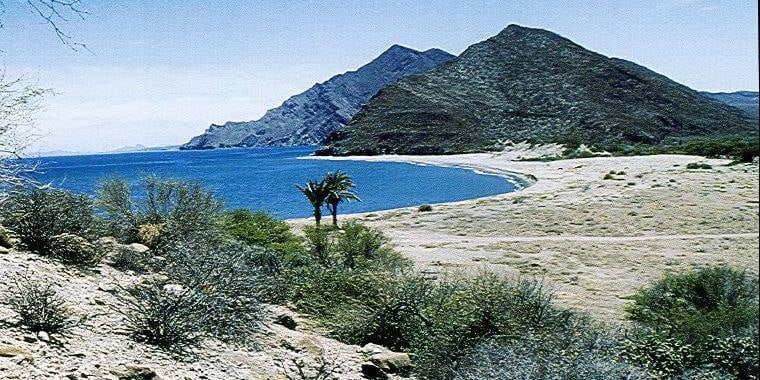
San Bruno Mission Site, Baja California Sur
Kino's Letter From San Bruno Mission, The Californias
December 8, 1684
Summary Letter XXVI: Kino writes two letters to the Duchess from San Bruno, California, on December 8, 1684. In the first, he reports on the provisioning of the California settlements from across the gulf. Projected expedition to the west coast. Building at San Isidro, the second Spanish settlement. Friendly attitude of the Indians; prospects for their conversion. Thanks for gift; no letter received from the Duchess. [1] |174|
The fact that no other ship but the “Almiranta” has come to California (or Carolinas [2]) has forced us to postpone the expedition which we planned for the months of October and November until the present, when during these months of December and January, we shall undertake it. The transportation from Yaqui of seventy horses and mules has necessitated four crossings of the Almiranta. Several of the natives of this country (both Edues and Didius) have enjoyed taking part in all four trips both going and coming.
In the meantime, at San Isidro, [3] a site three leagues inland, another fort has been constructed. Its garrison has built a large and roomy structure for the supplies to be taken on the |175| expedition: for forty to fifty days, and to be carried by eighteen pack-mules. At the fort of San Isidro was also erected a small church where Mass can be said with reverence; likewise a sufficiently large dwelling for a priest.
All the necessary supplies for the expedition are now being transported and stored at San Isidro. And so within two or three days, just as soon as we have sent back the Almiranta, we shall, by God's goodness, be starting off on the expedition. The Admiral, thirty armed men, ten to twelve servants (Christian Indians from the Mayo valley [4] ) and more than thirty pack-animals will make up the expedition. Twenty to thirty of the natives will accompany us; they are so friendly that they have been of the greatest assistance to us on such occasions, as also in all the building that we have undertaken. Several times, too, they have brought us, in all friendliness and good will, our animals which had strayed, thus inspiring us daily with ever higher hopes of their eternal salvation and that for them the most precious blood of Our Redeemer was not shed in vain.
Your Excellency, this letter is being forwarded to you by the “Virreina”, Condesa de Paredes. In another letter [5] which Father Francisco de Florencia is sending to you, I have expressed my gratitude for the incense figures which on the day of my religious profession [6] were burned on the altar of Nuestra Señora de Guadalupe. I have not yet received any letter from your Excellency. Assurance that you are enjoying good health, as I desire, would afford me great joy.
May Our Lord grant to your Excellency years of happiness as I wish for you.
Fort San Bruno, California (or Carolinas), December 8, 1684.
[Devotedly yours]
[Eusebio Francisco Kino]
Editor Note: Kino wrote in the second letter of December 8, 1684 after he just returned from San Isidro, "By her love [Our Lady of the Immaculate Conception], I plead with your Excellency to deign in your apostolic zeal, inspired from heaven, to help and promote this undertaking and conversion of the Nuevas Carolinas (formerly California), even interceding, if necessary, with his Catholic Majesty (whom By her love I plead with your Excellency to deign in your apostolic zeal, inspired from heaven, to help and promote this undertaking and conversion of the Nuevas Carolinas (formerly California), even interceding, if necessary, with his Catholic Majesty (whom God protect) and with the royal officials who are in charge of the financial assistance and other aspects of such enterprises ... in order that by no means any attempt be made to abandon these natives, so numerous, so docile and so friendly." Kino's second letter to the Duchess from San Brunо, The Californias, dated December 8, 1684.
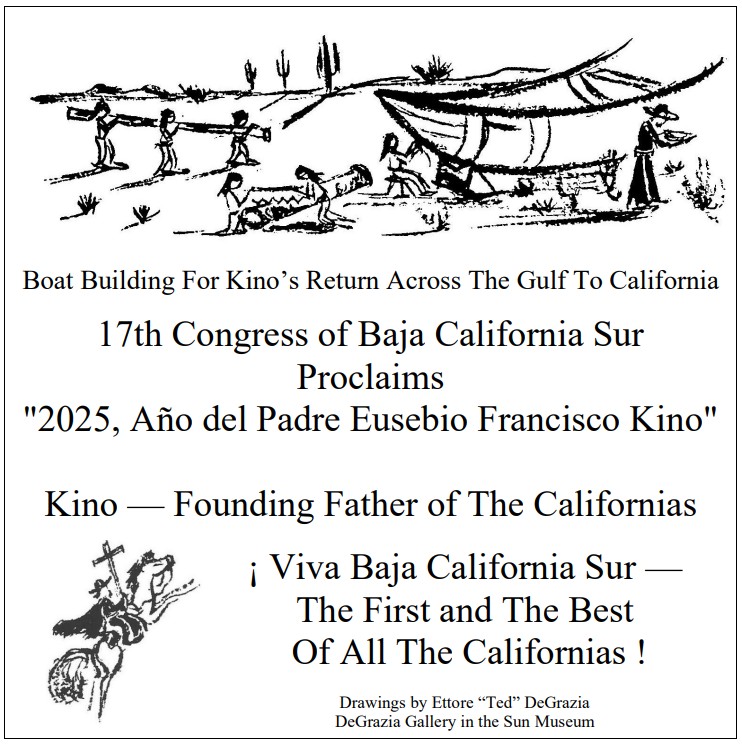
Celebration of Kino's Lifetime Contributions to Spanish Settlement of The Californias
Drawings by Ettore "Ted" DeGrazia
Kino's Last Letter From Mexico City
November 16, 1686
Summary Letter XXXII: |193| Kino writes to the Duchess from Mexico City on November 16, 1686, just before departing for his new mission field along the northernmost rim of Christendom. He has been in Mexico City some six months, ever since his return from the California expedition. He recounts the rescue of the Manila Galleon. The California enterprise has been suspended due to the incorrect information that there is unrest in Nueva Vizcaya. The new mission field to which Kino is setting out is across from and near to California. The new Viceroy is favorable to the missions. The conquest of California can be better supplied from across the gulf than from southern ports. Objections and answers. Exploring and settling farther north in California more productive lands would be found. Indians are tractable. Best remedy against prevalent sickness in California is fresh food. Missionaries are prepared to return: they know the languages and have won the confidence of the natives. Kino has composed a treatise on the region. He implores the Duchess to use her influence in saving the enterprise and to intercede in behalf of twenty-one English prisoners. [1] |193|
Your Excellency,
The Peace of Our Your Excellency, the Peace of Our Lord be with you!
Some six months ago, shortly after reaching Mexico City from California (or Carolinas), I wrote [2] to your Excellency giving you |194| an account of that vast Island's extensive mission field so ripe for the harvest of souls, and the heartrending pleadings which those gentle and tractable natives (after their instruction in the tenets of our holy faith) are making to receive holy baptism. [3] I also recounted how we sailed out in the California ships to meet and warn the Manila Galleon about the enemy pirates lurking along the coasts of the South Sea in order to capture it. By God's favor, we succeeded in bringing the Galleon into the port of Acapulco to the chagrin of the four enemy ships [4].
Afterwards, about the middle of January of this present year of 1686, we continued from Acapulco to Mexico City. In April, as we were on the point of returning to California to get on with the conversion of the many docile natives and gather in so ripe a harvest, a decree arrived from Madrid. Inasmuch as the previous year of 1685 a report had gone out from here to the effect that Nueva Vizcaya, [5] because of the natives' restiveness, was on the brink of ruin, the order came enjoining the assistance to and preservation of that province or territory of Nueva Vizcaya, even if this entailed the suspension of the California enterprise with its settlement and conversion. But as this suspension was effected not because of the peril to which Nueva Vizcaya is exposed (as the royal Attorney General [6] states in his reply of May 6th of the present year of 1686), four additional subsidies instead were obtained for four new missions: [7] two among the Tarahumaras and the others among the pagan Seri and Guayma Indians who live with insight of California, so close that only fifteen or sixteen leagues separate them. My superiors recently appointed me to found this new mission or missions among the Seris and Guaymas, who are also pleading for holy baptism. For this purpose I shall be departing, God willing, from Mexico City in just two days. [8]
Although we are hoping that the final decision for the continuing of the settlement and conversion of California (or Carolinas) will be a favorable one, and are consoled by the news that the next |195| Viceroy [9] is well disposed towards the missions through his devotion to the eminent apostle and angelic Saint Francis Xavier, and, further, are reassured by the grant of two subsidies for the two new missions among the Seris and Guaymas with the observation that the sum would thus help promote the continuity of the conversion of nearby California; despite all this, the uncertainty of the future is blocking or delaying the dispatch of the spiritual assistance for the salvation of so many souls so eager to receive holy baptism. [10] In all sincerity and from the depth of my heart, as also in the name of those gentle and tractable natives, I commend, not once but a thousand times, this enterprise to the holy zeal of your Excellency so that, when the occasion presents itself and you judge it opportune, you will deign to favor so holy a cause. To this end it would help to keep in mind the following three points. [11]
The first is that at present it is possible to secure the continuation of the settlement and conversion of California with a moderate and wisely employed sum from the royal treasury, [12] whereas since 1680 nearly half a million pesos have been spent [13] (that is, approximately one hundred thousand pesos each year), and the earlier expeditions [14] entailed an outlay of two million |196| more, namely those of Hernán Cortés in 1523, of Sebastián Vizcaíno in 1597 and 1602, of Francisco Ortega in 1634, of Admiral Pedro Porter Casanate in 1644, of Bernardo Bernal de Piñadero in 1677 and other attempts involving large ships and “longboards,” armed soldiers and marines, weapons, supplies and repairs; the expenditures for the discovery and settlement of California amounted to the sums stated above. But now with a couple of long boats and a small garrison of twenty or twenty-five soldiers and four to six missionaries (a total expenditure of some twenty thousand pesos and, if necessary, of even a smaller outlay), it is possible to effect the desired project of the peaceful settlement of California, as can testify many level-headed men with experience gathered during the last few years through their participation in the California enterprise.
Everyone knows how much the undertaking has suffered and has been retarded and how much useless expenditure has been incurred by employing large ships and sailing them over a route more than two hundred leagues from Compostela and Guadalajara in order to transport the provisions to California, with a delay of usually nine or ten months until the bulky shipment finally arrived and half rotten at that; whereas with a weekly crossing of long boats from Sinaloa and Yaqui, it would be easy to secure all that one might desire.
The second is that the settlement, enterprise and conversion of California has experienced many difficulties, obstacles and delays (purposely created, by the way). The enemy of mankind in the attainment of its salvation, furious that so great a prize, securely his for so many years, should slip from his grasp, associated with some others, has so resolutely opposed the Society of Jesus, that one may appositely say with the Apostle of the Gentiles in his First Epistle to the Corinthians, XVI, 9: “For a great door and evident is opened unto me; and many adversaries “.
Despite the large number of the difficulties, [15] they can be reduced to these three: the first, the great expense; the second, the |197| drought and unproductiveness of the land, so much so that some have not hesitated to say that the country is uninhabitable; the third, the diseases, especially scurvy, which during the past months of March, April and May of 1685 made victims of many soldiers.
The replies to these three difficulties are as follows. The solution to the first has been indicated above, namely in the first point discussed. The second difficulty states that the drought in California lasted a year and a half; it is at least extenuated by realizing that the drought was general; that is, almost everywhere in New Spain and North America, and that when we reached California on October 6, 1683, and proceeded to San Bruno, we found attractive and fertile lands with plentiful pastures for herds and suitable for planting, as Admiral Isidro de Atondo y Antillón wrote to the Viceroy in a letter dated October 15, 1683. The bit of maize and wheat and other grain which we then planted gave a yield equal to that of any part of New Spain; from the wheat harvested bread was made and the hosts with which for a long time the holy sacrifice of the Mass was celebrated.
Likewise, from the information furnished by the California natives, it is certain that farther north [16] there are lands which are level, rich and fertile, and with abundant water. There is a royal decree with the statement that on the 36th parallel there are trees to build ships of any tonnage. It is also certain that we have not yet seen one percent of California, which is so extensive that the distance from Cabo San Lucas [17] to Cabo Mendocino and Cabo Blanco is over five hundred leagues; [18] and, according to sea charts and the accounts of Sebastián Vizcaíno, Francisco Ortega, Pedro Porter de Casanate and others who on various occasions sailed over to California in order to explore the region (and their statements |198| agree with what the natives have told us), all of California is inhabited by numerous tractable and peaceful Indians. And should there at times be any scarcity of some provisions in California, they could be imported by small craft from the productive nearby regions, namely from the lands of the Seris, Guaymas, Sinaloans and Yaquis. Thus, the necessary help and alleviation could be secured.
As for the third difficulty, namely that of the diseases which they experienced during the past months of March, April and May, the same prevailed to an equal degree and with a high mortality rate in various parts of New Spain. Now, if instead of living in Fort Bruno [19] whose water supply turns very salty because of its proximity to the sea, headquarters were set up in the other fort (San Isidro and San Nicolás, or Los Reyes) or on some other site further inland where even in time of drought the sources furnish an abundance of good water, all would live less subject to such diseases. The most efficacious remedy against such as break out on board ship is to secure fresh provisions, and these can easily be brought over in small craft, namely the so-called “long-boats”. The third point is this. It is now very easy to effect the settlement and conversion of California, at least in various regions of the country, inasmuch as it lies only 25 leagues across the strait (in some places, only twenty, nineteen or sixteen leagues). This means a sea voyage of ordinarily twenty hours, and sometimes of only fifteen, twelve or even less. [20]
We have secured very good ports on both sides of this calm and tranquil gulf. We have learned two of the native languages [21] and have brought three California Indians to New Spain who already know Spanish well and can act as expert interpreters. [22] But what most facilitates |199| the settlement and conversion is that the people of California are so gentle, submissive and peaceful that even after our men on various occasions had slain a total of thirteen of them, [23] we received no harm from them by way of vengeance, but rather always signal kindness and esteem and even a truly devoted affection, especially the missionaries of the Society of Jesus, whom they consider as heaven-sent teachers and often in times of drought were asked to pray for rain, etc.
It is true that during the last two years to the present, we have baptized only eleven natives, [24] and these were on the point of death. Of the eleven three recovered, and these unfortunately have stayed behind among the pagans. The fewness of baptisms was due to the withholding during the years of the authorization to confer the sacrament with solemnity. The officials here in Mexico City were supposed to send us the decision to continue the enterprise of settling and converting the region, but because this decision was so slow in reaching us over the tortuous route it followed, we proceeded to Matanchel, a port on the mainland of New Spain. [25] We were immediately dispatched to meet and warn the Philippine Galleon; thus property aboard the Manila Galleon worth some four million pesos escaped by heaven's favor the pirates' grasp.
And although I have written a book in Latin, [26] called the New Carolinas, on all these themes relating to California, on the voyages and expeditions undertaken to date, on the inhabitants and their ways, on the other Jesuit missions and neighboring pagan tribes of North America, on the vast amounts of money in behalf of the welfare and eternal salvation of souls being spent by his Catholic Majesty (whom God protect) with so sacred intent and so generously, and Father Baltasar de Mansilla, [27] God willing, will take a copy of the book to Spain for publication if superiors approve, nonetheless in the meantime through this letter I come pleading on my knees in behalf of so many souls to the most |200| pious zeal of your Excellency, and beg of you, by the most precious blood of our Creator and Redeemer Jesus Christ, that you deign to assist and help us, as occasion offers in Madrid, in order that the advantage of so ripe a harvest and the vast expenditures of his Catholic Majesty (whom God protect) and the price paid for by the most sacred passion and death of Our Lord be not lost.
My superiors here have promised me that, on the arrival of a favorable decision from Madrid regarding the conversion of California, they will send me to continue in its missions, and then I shall turn over to another the foundations which I have made among the Seris and Guaymas. In just two days I shall be leaving from Mexico City for those missions; [28] I have been provided with church bells, chalices and altar furnishings. I repeatedly commend all to the fervent prayers of your Excellency, and ask Our Lord to keep your Excellency through the years in true happiness and increase of heaven-sent gifts, as I desire and these souls stand in need.
Mexico City, November 16, 1686.
Most devotedly yours,
Eusebio Francisco Kino
P. S. On the feast days of Saint Francis Xavier and of the Immaculate Conception of Our Lady, in accordance with my promise, [29] I shall offer, God willing, my Masses for the intention of your Excellency and the spiritual and temporal welfare of my dear friends, Joaquín, Gabriel and Isabel. I commend to your Excellency the twenty-one Englishmen whom we recently converted here; I refer to this in the hope that there may be some opportunity offered you of securing a mitigation of their prison term which is five years. Do pardon the trouble which my requests may entail. [30]
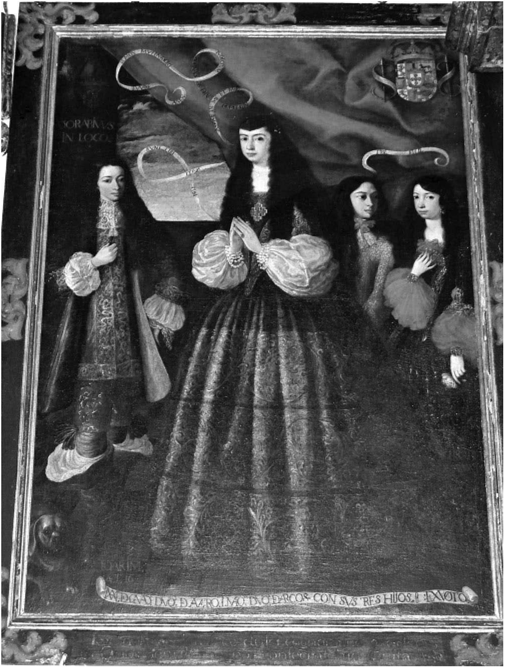
María de Guadalupe Duchess de Lencaster, 6th Duchess of Aveiro and Children
Painting Attributed to Artist Cerreño Miranda - 1682
Maria de Guadalupe de Lencastre, 6th Duchess of Aveiro
Memorandum on the Importance of The Return to The Californias
California is one of the vastest regions of America, if its full extent is taken into account. Its discovery, a desired goal for many years, was recently attempted by Isidro de Atondo, but as no really useful and signal enterprise is easy, it suffered a severe blow by his killing some of its inhabitants, through the failure to discover the riches expected, because of his Majesty's considerable outlay of money and his need elsewhere of the soldiers employed in the settlement and who now, so it is feared, will be ordered withdrawn.
It is up to the Viceroy to see to it that so many needy souls be not abandoned; rather, he should promote by special attention and protection those missions by ordering the Jesuits to continue there, inasmuch as three or four of their missionaries employed in them permanently could gather in for heaven's granaries most abundant harvests. They could be given an escort of a few soldiers, carefully picked and to the satisfaction of the Fathers. In this way the expenses would necessarily be very moderate. All could be solved, were the Viceroy to show that he cared for such a work of mercy; for men would surely endeavor to please him, inasmuch as in the Indies, as elsewhere, it is the will of the superior that convinces the minds of men. The advantages resulting from the possession and exploration of these regions are not stressed here, since they are so patently evident.
Maria de Guadalupe de Lencastre, 6th Duchess of Aveiro
Editor Note: Ernest J. Burrus summarizes the Duchess's memo to the Spanish Court: "An unsigned Memorandum in the hand of the Duchess on the size and importance of California. The efforts to settle the region. Atondo's recent expedition. A plea for the resumption of the enterprise: a practical and inexpensive program is outlined."
Ernest J. Burrus, Editor
Kino Writes to the Duchess: Letters of Eusebio Francisco Kino, S.J.,
to the Duchess of Aveiro (1969).
Copies of Kino's 1685 plan to revive the California enterprise was accepted by New Spain’s Viceroy. Copies of the plan went to his Jesuit superiors, friends in Europe, and in particular to the Duchess of Aveiro with the plea that she intercede with the highest Spanish officials in behalf of California. After the plan was approved by the viceroy, Kino's revival of California's settlement was "suspended" right before the ships were returning to California. Instead the small fleet was ordered to find the Manila Galleon sailing off the coasts of California and warn it of pirates in the area. The ships then escorted the Manila Galleon to Acapulco.
In a 1985 interview about his career and work, Burrus commented: "There are also the volumes of his [Kino's] correspondence with the Duchess of Aveiro (see nos. 16, 18), and I think that I reveal for the first time that she had the idea of the Pious Fund of the Californias. She submitted to the king in her own handwriting a plan that is the basis of the Pious Fund. I was so fortunate as to find that and I published it in these two volumes."
An Interview with Ernest J. Burrus, S. J.
The Hispanic American Historical Review, Vol. 65, No. 4 (Nov., 1985), pp. 633-655
Editor Note: Burrus writes in a footnote number 4 to Kino's second letter from San Bruno "Presumably, the Memorandum (Document XXXVID) in the Duchess's hand was the result of the present and subsequent requests on the part of Kino in his effort to save the California enterprise."
Kino wrote in the second letter of December 8, 1684 after he just returned from San Isidro, "By her love [Our Lady of the Immaculate Conception], I plead with your Excellency to deign in your apostolic zeal, inspired from heaven, to help and promote this undertaking and conversion of the Nuevas Carolinas (formerly California), even interceding, if necessary, with his Catholic Majesty (whom By her love I plead with your Excellency to deign in your apostolic zeal, inspired from heaven, to help and promote this undertaking and conversion of the Nuevas Carolinas (formerly California), even interceding, if necessary, with his Catholic Majesty (whom God protect) and with the royal officials who are in charge of the financial assistance and other aspects of such enterprises ... in order that by no means any attempt be made to abandon these natives, so numerous, so docile and so friendly." Kino's second letter to the Duchess from San Brunо, The Californias, dated December 8, 1684.
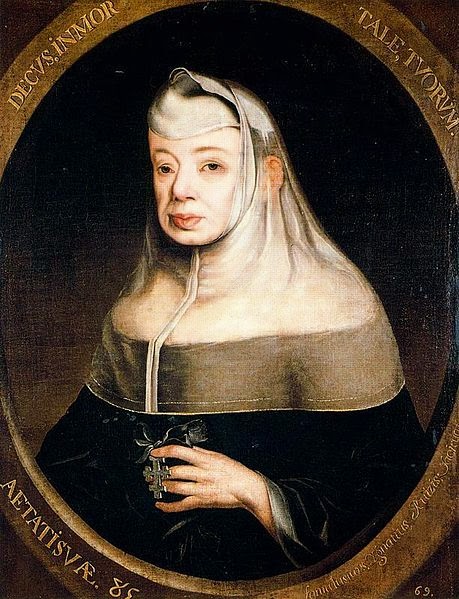
Maria de Guadalupe de Lencastre, 6th Duchess of Aveiro
Artist Francisco Ignacio Ruiz de la Iglesia (circa 1700)
Maria de Guadalupe de Lencastre, 6th Duchess of Aveiro
Duchess' Global View - Letter About The Importance of The China Mission
English Translation
[T]here is no doubt that the Chinese mission is the most consequential for the church in all of Asia[,] as much for the extensive reach of the empire as for the rigorous policies that all the other neighboring kingdoms attempt to imitate or emulate in rivalry[.] The need for evangelical workers is equal to the vastness of those provinces and to their great disposition against the Faith[.] Because the emperor prefers the risk of the Muslims multiplying and the schismatic Greeks re-entering through the peace treaties newly celebrated between China and Moscow, it is extremely urgent that missionaries travel to China via the Philippines[.] There are expeditions but no one can do so without it costing [at least] one thousand pesos From Spain to Manila only[.] The trip from Portugal presents major inconveniences because the navigation is difficult and lengthy[.]
Spanish Document Transcription
La mision de la China no se puede du[d]ar en ser la de maior consequencia para la iglesia en toda el Asia assi por lo dilatado de su imperio como por la exacta politica del que todos los mas reynos circumvecinos procuran imitar o emular a porfia la necessidad de operarios evangelicos es igual a lo vasto de aquellas provincias y a las grandes disposiciones en que se hallan para recibir la fee que el emperador favorece el riesgo que los mahotmetanos se multipliquen yy los griegos seimaticos se introduzgan por las pazes nuevamente celebradas ya entre el Sino y Moscovita es urgentissimo para pasar a la China religiosos por via de Philipinas tiene embarcaços y ningún sugeito puede lograrlo sin el coste de mil pesos desde España a Manila solamente la via de Portugal padece [maiores] inconvenientes porque la navegación es dificil y tarda . . . .
María Guadalupe de Lencastre, Duchess of Aveiro, ca. 1690, Draft of Letter to María Francisco de Salerno, S.J., Boxer Collection, Lilly Library, Indiana University
English translation and Spanish transcription by Jeanne Gillespie.
Jeanne Gillespie
Casting New Molds: The Duchess of Aveiro’s Global Colonial Enterprise
This same church, however, held high esteem for the patron of its missionary efforts. María Guadalupe de Lencastre came to be known as the “Mother of the Missions,” and she continued her pursuit of missionary success in China the rest of her life. Buoyed by the Treaty of Nerchinsk in 1689 between the Chinese and the Russians, she drafted a letter to the Jesuit María Francisco de Salerno in Palermo. In this letter the duchess spelled out the need to push harder to establish missions in China and the difficulty this would entail. In this correspondence the duchess continued to lobby for the provisioning of the Marianas via the Philippines in hopes that the supplies reached the missions in a timely manner and with minimal difficulty. This would also allow a closer monitoring of the church’s evangelical efforts in China. [22]
As in previous letters, the duchess’s interest in the logistics of the missionary enterprise and her awareness of the political implications of global affairs remained a major organizing principle of her discourse. Like the Jesuits, she was keenly attuned to the possibility of evangelization in China. While this dream would never become a reality, the duchess’s efforts both financially and politically did result in successful missions throughout the world. The Duchess of Aveiro was an able administrator as well as a devoted Catholic, who committed her energy and her resources to the causes in which she believed. An analysis of her communications, with numerous clues provided by her trans-Atlantic peer, Sor Juana Inés de la Cruz, reveals a successful entrepreneur who dedicated herself to colonial missionary effort for nearly thirty years, one who did not succumb to the pressures of society, husbands, or kings; and one who was never molded into an accepted model of female comportment.
[22] María Guadalupe de Lencastre, Duchess of Aveiro, ca. 1690, Draft of Letter to María Francisco de Salerno, S.J., Boxer Collection, Lilly Library, Indiana University.
Note included the text set out above of the English translation and Spanish transcription.
Jeanne Gillespie
Excerpt from
Casting New Molds: The Duchess of Aveiro’s Global Colonial Enterprise.”
Early Modern Women: An Interdisciplinary Journal 8 (2013): 301-16.
Entire article online at https://www.journals.uchicago.edu/toc/emw/2013/8
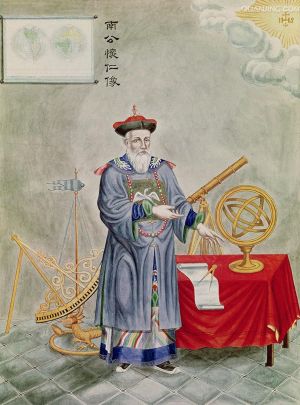
Jesuit Missionary Ferdinand Verbiest, S.J. - Emperor of China's Friend & Astronomer
Jesuit Missionary Verbiest Praises The Duchess
To His Friend, The Chinese Emperor
Jesuit Ferdinand Verbiest (1623-1688) was one of the most eminent Jesuit missionaries in China. Verbiest accompanied Kino’s cousin, Martino Martini, S. J., to China in 1657. Verbiest spent nearly thirty years in the Chinese mission, most of the time at Peking. Through his exceptional mastery of the Chinese language and literature, his mathematical and scientific knowledge, especially in astronomy, he was held in high esteem and was befriended by the Chinese Emperor K'ang-hsi. His great influence and prestige made possible the work of future Catholic missionaries in China. Kino in his letter (number IV) write to the Duchess about Verbiest's letter that pleas for more Jesuit missionaries in China.
Jeanne Gillespie
The ‘Mother of Missions:’ The Duchess of Aveiro’s Global Correspondence
on China and Japan, 1674-1694
In a letter dated 1685 from Thomas’s superior, Ferdinand Verbiest offered his appreciation for the duchess’s efforts and explained that he read one of her letters to the Chinese emperor and lauded her as “the Most Excellent Muse of all the liberal arts, whose company is eagerly sought for by Philosophy itself and by all Mathematical Sciences” (Aveiro 83).
Jeanne Gillespie
The ‘Mother of Missions:’ The Duchess of Aveiro’s Global Correspondence
on China and Japan, 1674-1694
Laberinto Journal 9 (2016)
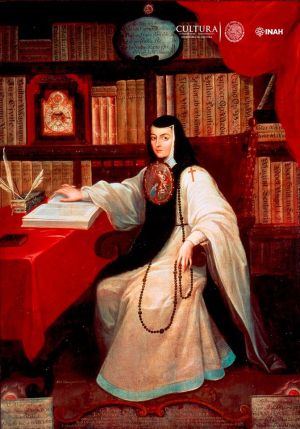
Sor Juana Inés de la Cruz - The 10th Muse
Sor Juana Inés de la Cruz
Sor Juana Writes About The Duchess
“Romance” Number 37 Poem
La respuesta a sor Filotea” [Response to Sister Filotea]
Ernest J. Burrus
Sor Juana's Poem "Romance" Number 37
The Mexican Poetess, Sor Juana Inés de la Cruz (1651-1695), wrote at the insistence of the Condesa de Paredes, wife of the Mexican Viceroy (1680-1686), a poem of one hundred and twenty lines in honor of the Duchess. The briefest of outlines must suffice here. After extolling her beauty, learning, literary talents and high nobility, the Poetess reminds the Duchess that flattery and self-seeking are not the motives of her poetic effusion. In a delightful parenthesis Sor Juana dilates on the natural resources and bounty of the New World. She then returns to the motive for writing the poem in her honor. This she finds in the Duchess's generosity to the missionaries and her zeal in promoting the Faith; the Duchess's goodness merits the gratitude expressed through the lines of the Poetess. The Spanish edition of the present correspondence reproduces the entire poem of Sor Juana.
Ernest J. Burrus
III. The Duchess: A Biographical Note
Kino Writes to the Duchess:
Letters of Eusebio Francisco Kino, S.J., to the Duchess of Aveiro
Margo Echenberg
Sor Juana as Panegyrist: In Praise of Doña María de Guadalupe de Lencastre
in The Fame of Sor Juana Inés de la Cruz Posthumous Fashioning
in the Early Modern Hispanic World
Sor Juana's Poem Romance Number 37
|219| Sor Juana’s ‘romance’ #37’, a laudatory work written in honor of a fellow author, Doña María de Guadalupe de Lencastre, Duchess de Aveyro (1630–1715), serves as an excellent introduction to a number of the Mexican writer’s poetically configured beliefs regarding representation and fame. Complex and engaging, Sor Juana’s ‘romance’ initially lauds the pious noblewoman in a manner akin to the hyperbolic elegies of the ‘Fama.’ ‘‘romance’ #37’ does much more, however, than simply mimic the conventional strategies of the baroque elegy. As a literary tribute to a woman also known as “la única maravilla de nuestros siglos” [the only wonder of our times], Sor Juana’s poem in honor of the Iberian duchess grants the New World writer an opportunity to reflect on the role of fame in the life of a woman writing in her time and on her own contradictory role as both a conventional and unorthodox elegist.
Sor Juana discloses in her poem that she learned of the Portuguese Duchess’s works from her patron, friend, and ally, the Marquise de la Laguna, herself a relation of María de Guadalupe de Lencastre. A letter written to the latter by the former has been recently unearthed at the Latin American Library of Tulane University and published in facsimile and transcribed versions (Calvo and Colombi 2015). It’s difficult to know when exactly Sor Juana wrote the poem. Méndez Plancarte groups ‘‘romance’ #37’ with three others that he estimates were written between 1680 and 1686. Published in the ‘Inundación castálida’ (IC), poem #37 could also have been composed in 1687 or 1688, the latter being the year in which the Marquises de la Laguna ended their eight-year stay in Mexico.
Over the course of her lengthy and at times digressive panegyric, Sor Juana comments on many of the topics that most preoccupied her own posthumous elegists: the relationship between sex and intelligence, the role of devotional writings in a woman’s renown, the motives behind the writing of elegies, and, finally, the nature of her own literary enterprise. Addressing each of these subjects as they pertain to the Duchess, Sor Juana also explicitly formulates an image of her self despite—and within—the rigid limitations of convention. In this ‘romance’, as she so frequently does in her self-referential poems, Sor Juana reviles herself and belittles her |220| work while extolling the Duchess. Nonetheless, as we will see, alongside her self-portrayal crafted with humility, the nun-writer offers an equally powerful image of herself as María de Guadalupe’s equal. As in all of the Mexican nun’s encomiums, she enters into a subject-object, or perhaps more precisely, a subject-subject relationship with her addressee. In other words, the poet and her addressee share the subject position in the poem’s distinct sections. In ‘romance’ #37 we witness the clever manipulation of the subject as the poet struggles to keep herself out of the tribute to the Duchess, but cannot:
¿Pero a dónde de ‘mi’ Patria
la dulce afición ‘me’ hace
remontar‘me’ del asunto
y del intento alejar’me’?
[But whence from ‘my’ homeland does ‘my’ sweet admiration make ‘me’ wander from the subject at hand?] (OC 1.103–4:125–28, emphasis added)
Before analyzing Sor Juana’s role as subject in ‘romance’ #37, however, a few words must be said about the nun-writer’s portrayal of the Duchess de Aveyro. All through the first twelve stanzas of the ‘romance’, the poet hyperbolically lauds María de Guadalupe de Lencastre with the following epithets: “alto honor de Portugal” [high honor of Portugal], “Venus de Mar Lusitano” [Venus of the Portuguese Sea], “Minerva de Lisboa” [Minerva of Lisbon], “cifra de las nueve Musas” [sum of the nine Muses], “honor de las mujeres” [honor of women], “primogénita de Apolo” [Apollo’s firstborn], “presidenta del Parnaso” [president of the Parnassus], and “clara Sibila Española” [illustrious Spanish sibyl] (OC 1.100–101). With her impressive list, the nun-writer clearly accentuates the Duchess’s sex and her literary and intellectual endeavors. By concluding her series of appellations with “alto asunto de la Fama” [of much importance to Fame], Sor Juana resolves that the Duchess deserves this most distinguished honor since she is a Spanish sibyl, “más docta y más elegante / que las que en diversas tierras / veneraron las edades” [more learned and elegant than those who in diverse lands have been venerated through the ages] (OC 1.101:42–44). Indeed, the Mexican writer freely compares her contemporary’s erudition and literary excellence to the talent of Minerva, the Sibyls, the Muses, and Apollo, by means of a rationale that I have shown to exist in elegies dedicated to Sor Juana both during and after her lifetime:
claro honor de las mujeres,
de los hombres docto ultraje,
que probáis que no es el sexo
de la inteligencia parte
[Illustrious honor of women, insult to learned men, you prove that sex plays no part in intelligence]. (OC 1.101:29–32)
In her elegy to the European duchess, Sor Juana lauds the qualities not just of any woman writer, but rather of a true ‘mujer fuerte’ blessed with intelligence, physical beauty, and extraordinary virtue
[...] los Padres
Misioneros, [...] pregonan
vuestras Cristianas piedades,
publicando cómo sois
quien con celo infatigable
solicita que los triunfos
de nuestra Fe se dilaten
[The Missionary Fathers preached your Christian pieties, announcing how it was you who requested, with indefatigable zeal, that the triumphs of our Faith be known]. (OC 1.104:150–56)
The piety of María de Guadalupe, a writer of exclusively religious works, was widely celebrated in her time. In addition to her religious writings, the Duchess maintained correspondence with several Jesuit missionaries. Sor Juana’s reference to the “Missionary Fathers” may therefore denote Father Kino, whose works she had read (Sabat-Rivers 1997, 17; Paz 1982, 343). Sabat-Rivers contends that it is likely that Sor Juana knew of María de Guadalupe’s spiritual exercise: ‘Los siete dias de la semana contra los siete pecados capitales [...]’. For, despite the fact that the nun’s ‘Ejercicios de la Encarnación’ comprise a nine-day cycle of prayer, the first seven days follow the Duchess’s work almost exactly (1997, 18). [4N]
Sor Juana’s ‘romance’ also displays its adherence to tradition by alluding to the noblewoman’s physical appearance. In fact, the nun-writer invokes María de Guadalupe’s physical presence by subscribing to a widespread |222| commonplace included in tributes dedicated to women: the description of her beauty. Physical beauty was not seen as something absolute in the early modern period, but as reflecting a woman’s moral character and thus was a necessary part of all encomiums. Taking its cue from Neoplatonic and courtly love traditions, the subject or beloved—in this case, the Duchess—ennobles the poet spiritually in that her beauty is both a source of divine virtue and the embodiment of human perfection (Greer 1979, 61–62). At the juncture of ‘romance’ #37 in which Sor Juana praises the beauty of her subject, she also introduces the Marquise de la Laguna into the poem, thus making the total number of subjects three. In order to extol both women fairly, Sor Juana has them complement (and compliment) each other:
de un Ángel sólo puede
ser coronista otro Ángel.
A la vuestra, su hermosura
alaba, porque envidiarse
se concede en las bellezas
y desdice en las Deidades
[Only an Angel can be the chronicler of another Angel. She praises your beauty because envy is allowed in beauties and is denied in deities]. OC 1.105:169–72)
Sor Juana doesn’t write herself into this trilogy. Instead, by reflecting on her actions as an elegist, the Mexican nun begins to undermine the traditions she proves to know so well by introducing textual strategies that both call attention to herself and divert it away from her. By revealing her own incentives—or lack thereof—for writing to the Duchess, Sor Juana comments on the purpose of the poetic tribute in her time (Luciani 2004, 150). This is undoubtedly one of the most interesting nuances of ‘romance’ #37, for the poet’s intrusion in the encomium tears at its very nature. Amy Katz Kaminsky has aptly noted that the poem “mak[es] manifest what is usually suppressed: the egocentrism of the writer of the eulogistic form” (1990, 142). If we are to believe the nun-writer, both the elegist and the object of praise stand to benefit it from a laudatory poem that doubles as a favor. However, in this particular case, neither of the two women will benefit.
‘Desinteresada’ os busco:
que el efecto que os aplaude |223|
es aplauso a lo entendido
y no lisonja a lo grande
[I seek you ‘disinterestedly’: [know] that the effect that I praise you with is learned applause and not exaggerated flattery]. (OC 1.102:65–68, emphasis added)
With her customary humility, Sor Juana assures the Duchess that her verses can do little to extend the noblewoman’s renown:
Porque ¿para qué, Señora,
en distancia tan notable
habrán vuestras altiveces
menester de mis humildades?
[Because for what purpose, over such large distances, my Lady, has your pride need of my humility?]. (OC 1.102:69–72)
While continuing to address María de Guadalupe, who has abruptly ceased to be her subject, the poet writes that she, in return, does not expect to receive any of the myriad favors that a literary tribute can grant its author:
Yo no he menester de Vos
que vuestro favor me alcance
favores en el Consejo
ni ampara en los Tribunales;
ni que acomodéis mis deudos,
ni que amparéis mi linaje,
ni que mi alimento sean
vuestras liberalidades
[I have no need of you, no need for the favors you can earn me before the Council, nor protection in the Courts; nor that you pay off my debts, nor that you protect my lineage, nor that my sustenance be your generosity]. (OC 1.102:73–80)
With these verses, the poet doesn’t place herself on par with the Duchess, as she seems to suggest when she wrote that only an angel (the Marquise) can chronicle another angel (the Duchess). Instead, she writes from a position of recognizable otherness: the result of American fecundity: “Que yo, |224| señora nací / en la América abundante, / compatriota del oro, / paisana de los metales” [I, milady, was born in the abundant America, a compatriot of gold, a kinswoman of metals] (OC 1.102: 81–84). Indeed, she was born in “la América abundante” [Abundant America],
adonde el común sustento
se da casi tan de balde,
que en ninguna parte más
se ostenta la Tierra Madre.
[where common sustenance is taken for granted such that Mother Earth can boast [her wares] here more than anywhere else]. (OC 1.102–3:85–88)
se da casi tan de balde,
que en ninguna parte más
se ostenta la Tierra Madre.
[where common sustenance is taken for granted such that Mother Earth can boast [her wares] here more than anywhere else]. (OC 1.102–3:85–88)]
In ‘romance’ #37, Sor Juana repeats three times that her only intention is to prostrate herself at the Duchess’s feet (vv. 35; 187; 189). According to her ‘romance’ , as an inhabitant of America, a world of plenty rich in minerals and sustenance, and as a nun whose vows of poverty govern her life, Sor Juana need not petition María de Guadalupe for influential nor material favors; she is truly “desinteresada”—or so she says. [5N]
No matter how Sor Juana describes her designs in her tribute to the Duchess, the very act of writing the panegyric exalts and contributes to the noblewoman’s fame much in the way that Sor Juana’s own panegyrists of the Fama participate in her renown. In other words, while insisting that the object of her praise stands to gain nothing from her endeavor, the poet actively spreads the Duchess’s renown. Regardless of whether the nun knew that her poem would figure among those works published in the widely circulated and reprinted IC, she had to know that her works reached far and wide, abetted by intercessors like the Marquise de la Laguna. All too familiar with the prescriptions governing a sanctioned fame, Sor Juana makes certain to subscribe to tradition in her portrayal of María de Guadalupe. The nun-writer not only warrants the Duchess de Aveyro’s literary fame by relegating intellect to the sphere of the soul, she also underlines the fact that the Duchess’s literary endeavors are religiously motivated and extols her beauty. |225|
When Sor Juana turns her attention to herself in the final section of ‘romance’ #37, the telling gap between what she says and does is even more apparent. Significantly, the nun’s mastery of the genre together with her ability to exploit the variable nature of images allow her to transform conventional tropes into windows to her ever-mutable self. Appropriately beginning the last twenty verses of the ‘romance’ with the word “yo,” her person—or, importantly, the image of her—becomes the object of Sor Juana’s attention. Her intention, she reminds us, is no more than to prostrate herself before María de Guadalupe, an act that she will perform vicariously through her ‘romance’. Showing unmatched humility, Sor Juana attests that as a New World woman writer she has no influence and is of little consequence. She is in fact no one:
De nada puedo servitors,
Señora porque soy nadie;
Mas quizá por aplaudiros
Podré aspirar a ser alguien
[I can be of no use to you, my Lady, because I am no one. Only, perhaps, by praising you, can I aspire to be someone]. (OC 1.105:193–96)
Taken at face value, the nun-writer’s lines suggest that she can hope only, at best, to be a panegyrist of the Duchess de Aveyro; to be a learned servant, if you will. Hence despite claiming to be “desinterested,” Sor Juana admits, albeit rhetorically, to aspiring to be “someone” by means of her tribute. This potential someone (“alguien”), however, not only stands in contrast to, but is undermined by the nun’s utterance of self-negation (“soy nadie”) [I am no one] that appears in the very same stanza. Granted, Sor Juana here seeks recourse to a humility topic and thus necessarily adheres to tradition, either for its own sake or to reveal within convention a disquieting self-image. As Stephanie Merrim explains, “[p]sychologically, [humility topics] supply a conventionalized vehicle for emotions or interiority and can act as enabling disclaimers; rhetorically, they capture the reader’s sympathy and ally the writer with tradition” (1999, 174). With the aid of the humility topic and despite being joined to the equally conventional notion that her interlocutor can potentially ennoble her, Sor Juana offers only one possibility for self-representation in this stanza: self-effacement.
The language and imagery by which Sor Juana’s utterance of self-negation makes itself manifest, however, contradicts the disparaging message. More |226| specifically, Sor Juana employs language and metaphors that characterize a particular bent of her self-representation: her quest for knowledge and her personal sense of daring. For example, the Mexican nun describes her mission to laud María de Guadalupe as “un impulso dominante de resistir imposible” [A dominant impulse, impossible to resist] (OC 1.105:74–75).
Her words call to mind another “natural impulso” [natural impulse]. I am referring to Sor Juana’s description of her irrepressible inclination towards secular knowledge and writing in her ‘Respuesta’ and the ‘Carta al P. Núñez.’
Furthermore, in speaking of her metaphorical voyage to “la dichosa región” [the fortunate region] (Europe), carried out “con pluma en tinta, no en cera, / en alas de papel frágil” [with quills of ink, not wax, on wings of fragile paper] (OC 1.105:77–78), Sor Juana refers to the figure of Icarus, a recurring image of daring in her work as Sabat-Rivers (1998, 90) and Merrim have convincingly argued (1999, 173; 204). Used here to describe the nun’s transatlantic voyage from New Spain to the Duchess’s feet via her poem, the reference to Icarus also anticipates the greater act of daring to come—the publication (in Spain) of the IC. I concede that there is no way of knowing definitively whether Sor Juana was aware of the immanent publication of the IC. However, it is most likely that the poet entrusted the Marquise with delivering her tribute to the Duchess, be it in print or manuscript form.
If, on the one hand, what Sor Juana writes or says in her tribute to María de Guadalupe de Lencastre subscribes to the conventions of the elegy and employs humility topics that demand expressions of self-denigration, the language at the end of the poem undermines the nun’s attempt at self-obliteration. Her conflicting sentiments—I am no one, yet I am daring Icarus—signal ever-present opposing forces in Sor Juana’s self-representation. Complex and layered, her opinions of self, fame, and the act of writing are often contradictory. In ‘romance’ #37, the nun-writer proves her complexity while arguing that she is no one at all.
And, just as the ‘romance’’s intricate final section reveals that Sor Juana’s motives for writing the elegy are more complex than she willingly admits, another stanza affirms a parallel between the nun-writer and the Duchess by suggesting a potentially reciprocal literary exchange. Upon introducing herself in the poem, the Mexican nun insists that she writes from the peripheries of New Spain “in response” to the European woman’s renown:
al eco de vuestro nombre,
que llega a lo más distante,
medias sílabas responde
desde sus concavidades [...] |227|
[The echo of your name reaches the farthest latitudes and from their concavities half syllables reply]. (OC 1.102:53–56)
Sor Juana’s suggestion implies that on intellectual grounds the two women are equals—hers is “aplauso a lo entendido” [learned applause]—a fact she later affirms in her ‘Respuesta’ when she includes María de Guadalupe as her closest contemporary in her catalogue of learned women. [6N]
Moreover, Sor Juana again reneges on her supposed inferiority vis-à-vis the Duchess by textually displaying her erudition. As evinced in the lines cited above, the Mexican nun borrows the images and adjectives she employs to laud the Duchess’s learning—“imanes” [magnets], “compases” [compasses], “concavidades” [concavities], “ecos” [echoes], “sílabas” [syllables]—from the worlds of science and music. Whether intentionally or not, by postulating the Duchess de Aveyro as a world-renowned woman writer worthy of a literary tribute whose intelligence is not problematic but rather responsible for her fame, Sor Juana necessarily draws a parallel with her own life.
The Mexican poet’s encomium ratifies at every turn that María de Guadalupe de Lencastre’s qualities and achievements, those of a true ‘mujer fuerte’, render her worthy of her renown. However, in virtually all of her self-referential writings Sor Juana claims to abhor the very thing that she helped extend in the Duchess: her fame. Repeatedly insisting that she does not want to be portrayed as an icon, the nun adamantly dismisses her contemporaries’ claim that she too is a “única maravilla” [unique wonder] who deserves widespread renown. If in her ‘romance’ #37 Sor Juana refers |228| to willingly building temples in honor of the Duchess de Aveyro in America “[...] en este apartado Polo / templo os erijo y altares” [in this far-off Pole, I build altars and temples for you] (102:63–64), in what is arguably her autobiographical speech as the character Leonor in ‘Los empeños de una casa’, she reproaches those individuals who wish to do the same for her:
Era de mi patria toda
el objeto venerado
de aquellas adoraciones
que forma el común aplauso;
[...]
llegó la superstición
popular a empeño tanto
que ya adoraban deidad
el ídolo que formaron (OC 4.37–38:321–32)
[I was, through all my native land, / recipient of praise and laud, / the quality of veneration / formed by communal acclaim; / [...] too soon, a general superstition / was so insistent and widespread / that the idol they’d created / now the people deified]. (Juana Inés de la Cruz 1997, 244–45) [7N]
Leonor’s account tells of a life filled with virtue, talent, and beauty, until, that is, she became an “idol” to those who spread her acclaim. In their hands, reveals Leonor/Sor Juana at the end of her speech, her “dichas” [fortunes] have proven to be “desdichas” [misfortunes] (Merrim 1999, 156). How then to explain Sor Juana’s double standard? Why does she help extend the Duchess de Aveyro’s fame but despise her own? In order to answer these questions, we must first look at the nun’s (written) opinion of her acclaim.
NOTES
Note [4N] The common source for both works is most likely Sor María de Ágreda’s La mística ciudad de Dios (1670) (Merrim 1999, xii).
Note [5N] Together with her praise of America’s bounty, Sor Juana includes a commentary on European greed. Given that this is a rare instance of criollo pride in the nun-writer, this aspect of ‘romance’ #37 has received more attention. See, for example, Lafaye (1974, 71–72). For a reading of the poem in its political dimension in which Sor Juana presents the Atlantic as a space of leveling equilibrium that allows both sides of the ocean to be conceived of on the same grounds, see Morales (2010.)
Note [6N]
Moreover, Sor Juana again reneges on her supposed inferiority vis-à-vis the Duchess by textually displaying her erudition. As evinced in the lines cited above, the Mexican nun borrows the images and adjectives she employs to laud the Duchess’s learning—“imanes” [magnets], “compases” [compasses], “concavidades” [concavities], “ecos” [echoes], “sílabas” [syllables]—from the worlds of science and music. Whether intentionally or not, by postulating the Duchess de Aveyro as a world-renowned woman writer worthy of a literary tribute whose intelligence is not problematic but rather responsible for her fame, Sor Juana necessarily draws a parallel with her own life. The Mexican poet’s encomium ratifies at every turn that María de Guadalupe de Lencastre’s qualities and achievements, those of a true ‘mujer fuerte’, render her worthy of her renown. However, in virtually all of her self-referential writings Sor Juana claims to abhor the very thing that she helped extend in the Duchess: her fame. Repeatedly insisting that she does not want to be portrayed as an icon, the nun adamantly dismisses her contemporaries’ claim that she too is a “única maravilla” [unique wonder] who deserves widespread renown. If in her ‘romance’ #37 Sor Juana refers to [6] In her ‘romance’ #38 (to Doctor Don José de Vega y Vique) Sor Juana again presents the Duchess as her closest contemporary in an extensive list of women writers and thinkers deemed worthy of praise:
de la excelsa Duquesa
de Aveyro, de nuestro siglo
honra y corona, y gloriosa
afrenta a los antiguos:
en cuya divina pluma,
en cuyos altos escritos,
España goza mejores
Oráculos Sibilinos.
[Oh, the excelsior Duchess de Aveyro, honor and crown of our century, and glorious requirement of the Ancients: in whose divine quill, in whose esteemed writing, Spain enjoys the best oracles of the sibyls]. (OC 1.110–11:189–96)
For more on Sor Juana’s use of the catalog see Harvey (2006) and Peraita (2010) |228|
Note [7N] See Juana Inés de la Cruz (2005) for a bilingual Spanish-English edition of the play.
Margo Echenberg
Sor Juana as Panegyrist: In Praise of Doña María de Guadalupe de Lencastre
in The Fame of Sor Juana Inés de la Cruz Posthumous Fashioning
in the Early Modern Hispanic World
Editor Note: In the text above, the editor has indicated italized text in the original chapter by enclosing the italized text in single parenthesis. Original note numbers have the addition of the letter "N" inside the brackets to make searching the text easier.
The book "The Fame of Sor Juana Inés de la Cruz Posthumous Fashioning
in the Early Modern Hispanic World" by Margo Echenberg can be downloaded at
https://dokumen.pub/the-fame-of-sor-juana-ines-de-la-cruz-posthumous-fashioning-in-the-early-modern-hispanic-world-9789048552894.html
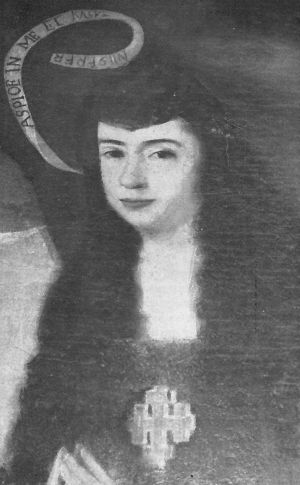
María de Guadalupe Duchess de Lencaster, 6th Duchess of Aveiro and Children
Painting Attributed to Artist Cerreño Miranda - 1682 - Detail
Kino and Sor Juana's Women of Intellect
"La respuesta a sor Filotea"
[Response to Sister Filotea]
Maria Guadalupe de Lencastre, 6th Duchess of Aveiro, is praised by Sor Juana Inés de la Cruz after extensively writing about the lives of the many women throughout history who had great intellect and pursued intellectual endeavors. In the private letter and now famous essay entitled “La respuesta a sor Filotea” [“Response to Sister Filotea” 1691], Sor Juana also praised two other living women at the time - Queen Christina Alexandra of Sweden and the Countess of Villaumbrosa of Spain.
Sor Juana wrote “Sin otras que omito por no trasladar lo que otros han dicho (que es vicio que siempre he abominado), pues en nuestros tiempos está floreciendo la gran Cristina Alejandra, Reina de Suecia, tan docta como valerosa y magnánima, y las Excelentísimas señoras Duquesa de Aveyro y Condesa de Villaumbrosa.” [And many others who I omit in order not to cite what others have said (a vice I always despise,) for in our day the great Christina Alexandria, Queen of Sweden, as learned as she is valiant and magnanimous, and the Most Honorable Ladies, The Duchess of Aveiro and the Countess of Villaumbrosa are flourshing.]
As discussed on this page, Kino and the Duchess had a very personal letter writing relationship. Kino and Sor Juana had a timeless friendship. Kino visited Sor Juana while he was in Mexico City awaiting for his mission assignments. Sor Juana wrote a poem in 1683 about Kino before Kino left Mexico City for the unsettled Baja peninsula, Kino’s first mission assignment.
To read Sor Juana's sonnet, "Praising The Astronomical Science Of Father Eusebio Francisco Kino Of The Company Of Jesus, Who Wrote About The Comet That Appeared In 1680, Absolving It Of Evil Portent" and poem commentaries, click
http://padrekino.com/index.php/khs_home/kino-life/sor-juanas-kino-poem
In 1691, Sor Juana was reprimanded by the church authorities and ordered to stop writing after “La respuesta a sor Filotea” was exposed in which she emphasized the right of women to education. Sor Juan is considered one of the most important writers in Spanish language literature.
As a teenager, Kino most likely saw Queen Christina of Sweden (1626-1689) after she voluntarily gave up her crown after reigning for 20 years. Queen Christian and her entourage of 255 persons and 247 horses, rode by Kino’s parent’s home in the Alps. Before Queen Christina publicly announced her conversion to Catholicism in Innsbruck. She was on her way to meet the Pope in Rome. Queen Christina was called the "Minerva of the North" due to her support of arts, humanities and sciences which she continued after she gave up her crown.
To read in English translation Sor Juana's remarkable letter “La respuesta a sor Filotea” in pdf format from the book “Sor Juana Ines De La Cruz: Selected Works translated by Edith Grossman, click
https://olli.gmu.edu/docstore/400docs/1801-406-sj%20respuesta%20excerpt%20eg%20trans.pdf
To read in Spanish “La respuesta a sor Filotea,” click
https://www.ensayistas.org/antologia/XVII/sorjuana/sorjuana1.htm
Eusebio Francesco Chini Epistolario 1670-1710
Domenico Calaraco, Editor
Eusebio Francesco Chini Epistolario 1670-1710
Domenico Calaraco, Editor
Ninety-five Kino Letters
A collection of 95 letters written by Kino that are translated into Italian with editorial notes by Father Domenic Calarco, the Vice Postulator of Kino sainthood cause. The collection includes Kino's letters to his fellow Jesuits and superiors like the Jesuit Father Generals Thirso González and Gian Paolo Oliva. Also there are two letters written to the King of Spain three years before Kino's death. Two view and download the collection, click
http://padrekino.com/index.php/download_file/view/eead3e5b-efc2-4e46-923e-953e0e8e34b8/411